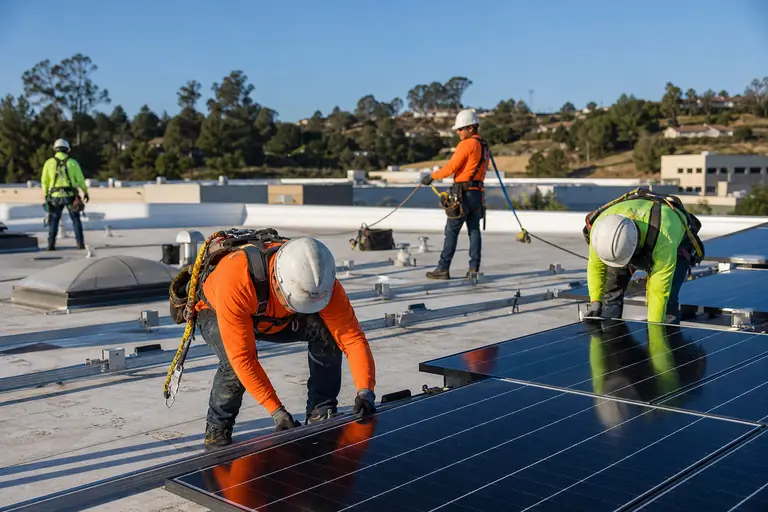
What solar really costs a small business depends on system size, roof condition, electrical upgrades, financing and how much of the power you use on site. The installed price is only half the picture. Under California’s net billing tariff, exported power earns far less than power you use yourself, so the true cost is measured by how much of your SDG&E bill the system actually offsets. Get at least three itemized quotes and compare them on that basis.
What goes into the price
A commercial quote bundles several costs. Ask for each one separately so you can compare fairly.
- Equipment: panels, inverters, racking, monitoring and, if included, batteries.
- Labor and design: engineering, installation crew time and project management.
- Electrical upgrades: older San Diego buildings sometimes need a new main panel or switchgear before solar can connect. This line can surprise you.
- Roof work: repairs, re-roofing or structural reinforcement. Panels last for decades, so a roof near the end of its life should be dealt with first.
- Permits and interconnection: city or county permits plus SDG&E interconnection under its Rule 21 process.
- Ongoing costs: monitoring, inverter replacement over the system’s life, cleaning and insurance.
Prices move with equipment markets, tariffs and installer workload. Treat any per-watt figure you read online as a rough guide and rely on itemized local quotes.
Why self-consumption matters under net billing
California’s net billing tariff, adopted by the CPUC and in effect for new SDG&E solar customers since April 2023, credits exported power at values that vary by hour and are generally well below retail rates. Power you use on site offsets your full retail rate. That changes the math in three ways.
- Size the system to your daytime load, not your annual total. An oversized system exports more power at low value.
- Businesses with strong daytime use (offices, shops, light manufacturing, cold storage) tend to see better returns than those that use most of their power at night.
- Batteries can store midday solar for the evening peak, when SDG&E time-of-use rates are highest. They add cost but can improve the overall return.
Our guide to California’s net billing tariff for commercial solar explains the rules in more detail.
Ways to pay
How you finance solar changes the cost more than most owners expect.
- Cash purchase: highest upfront cost, lowest lifetime cost, and you own the system and any tax benefits.
- Loan: you own the system and pay over time. Compare the loan payment to your expected bill savings.
- Lease or power purchase agreement (PPA): a third party owns the system and you pay a monthly fee or a price per kWh. Little or no upfront cost, but less savings and a long contract. Read the escalator clause and the end-of-term options carefully.
- PACE financing: available in some areas for commercial property owners, repaid through the property tax bill. Check current availability and terms.
Federal tax credits for commercial solar were cut back by federal legislation in 2025, with deadlines tied to when construction starts and when systems are placed in service. Ask your accountant what, if anything, still applies to your project before you count it in the math.
San Diego factors that change the numbers
Local conditions matter. Inland sites in Escondido, El Cajon or Santee usually get more sun and higher cooling loads than coastal sites in Encinitas or Coronado, where marine layer mornings cut early production. Your electricity provider matters too. If your city is served by San Diego Community Power or Clean Energy Alliance, SDG&E still delivers the power, but your generation rates and export credits may differ, so ask your installer to model your actual rate schedule.
Ownership of the building matters as well. If you lease, the landlord has to agree to the installation. Expect a roof access agreement, an insurance review and a plan for what happens to the system if you move. Settle those terms before you sign with an installer, because they affect whether you buy, finance or sign a PPA.
How to compare quotes
- Give every installer the same twelve months of SDG&E interval data, which you can download from your SDG&E account.
- Ask each one for itemized pricing, a production estimate, a self-consumption estimate and the rate schedule they modeled.
- Compare the projected bill savings, not just the system size or price per watt.
- Check what the warranty covers (panels, inverters and workmanship) and who honors it if the installer closes.
- Confirm a valid California contractor license with the CSLB and ask for local commercial references.
Be wary of a quote that promises the bill will disappear. Under net billing, most businesses still pay SDG&E something every month. An honest installer will show you where the remaining charges come from, including fixed charges, non-bypassable charges and evening usage the panels can’t cover. Ask to see a sample bill for month one.
How chamber membership helps
The San Diego Green Chamber connects businesses with installers, roofers and electricians who share a commitment to measurable steps, since every member commits to reducing energy and water use. You can find solar companies through the Member Business Directory, compare notes with peers at free networking events co-hosted with San Diego Green Drinks and see how the chamber supports the solar and storage industry. Learn about membership.
Questions
How much does commercial solar cost in San Diego?
It depends on system size, roof and electrical work, and financing. Prices change with equipment markets, so get at least three itemized local quotes and compare projected bill savings, not just price per watt.
Is solar still worth it under net billing?
It can be, especially for businesses with strong daytime use. Under net billing, power you use on site is worth far more than exported power, so size the system to your daytime load.
Should I add batteries?
Batteries add cost but can shift midday solar into the evening peak, when time-of-use rates are highest. Ask your installer to model the system with and without storage.
Are there still federal tax credits for business solar?
Federal legislation in 2025 cut back commercial solar credits with deadlines tied to construction start and placed-in-service dates. Ask your accountant what applies to your project.
Prove it. Get referred for it.
Join the San Diego Green Chamber to get listed, introduced and referred by businesses that check.