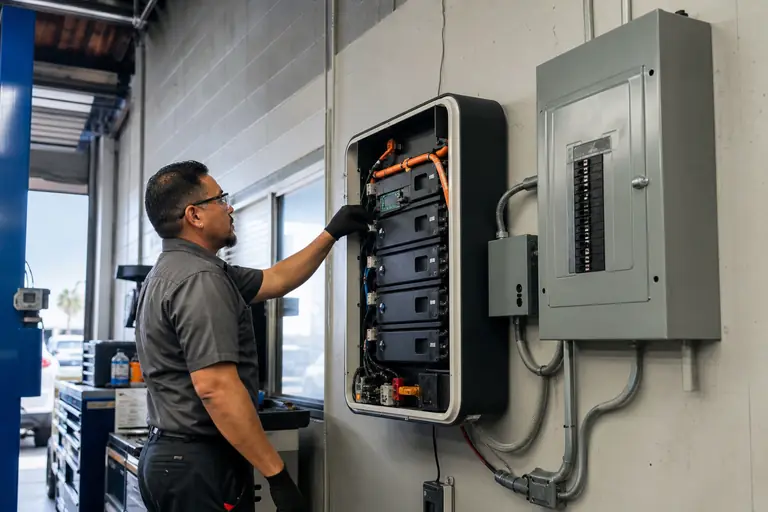
Battery storage helps a San Diego business in three ways: it shifts solar power from midday into the expensive evening peak, it can shave the demand charges on a commercial SDG&E bill, and it keeps critical equipment running during an outage. Whether it pays depends on your rate schedule, your load pattern and whether you pair it with solar. For many businesses installing solar under California’s net billing tariff, storage is now part of the standard conversation.
Why storage matters more now
Under the net billing tariff that the CPUC adopted for new solar customers, power you export to the grid earns hourly credit values that are generally far below retail rates. Power you store and use yourself later in the day offsets the full time-of-use rate. SDG&E’s on-peak period falls in the late afternoon and evening, after solar output drops. A battery bridges that gap.
That is the core shift. Solar alone was once valued mainly by how much it produced. Today, solar plus storage is valued by how much of your own bill it covers, hour by hour.
Three jobs a battery can do
Time-of-use shifting
The battery charges from solar in the middle of the day and discharges during the evening peak. Businesses that operate into the evening, such as restaurants, gyms, retail and assisted living, tend to benefit most.
Demand charge reduction
Many commercial rate schedules include demand charges based on your highest short burst of power use in a billing period. A single spike from compressors, ovens, chargers or HVAC units starting at once can set that charge for the whole month. A battery with smart controls can discharge during those spikes and flatten the peak. The savings depend on how often and how sharply your load spikes, so interval data is essential.
Backup power
A battery configured for backup can keep refrigeration, servers, security, point-of-sale or lighting running when the grid goes down. SDG&E may shut off power in high fire-risk areas of the backcountry and inland communities during dangerous wind events, so backup has real value for businesses in places like Ramona, Alpine or the eastern edges of El Cajon and Escondido. Backup requires a different electrical design, often with a critical-loads panel, so decide early if you want it.
Incentives and financing
The Self-Generation Incentive Program (SGIP), overseen by the CPUC, has offered rebates for battery storage, with higher incentives at times for customers in high fire-threat areas, critical facilities or underserved communities. In SDG&E territory, the program has been administered by the Center for Sustainable Energy. Funding comes in steps and can run out or be waitlisted, so check current availability before you plan around it.
Federal tax incentives for storage changed under 2025 federal legislation. Some storage credits remain under different terms than solar, but the rules are detailed and date-sensitive. Talk to your accountant before you count any credit.
How to size a commercial battery
Sizing comes down to two numbers: power (kW, how fast the battery can discharge) and energy (kWh, how long it can run at that rate). Get both right for your actual use.
- Download at least twelve months of 15-minute interval data from your SDG&E account.
- Identify your evening peak usage and your highest demand spikes, with the time of day they occur.
- Decide which jobs matter: bill savings, backup or both.
- If you want backup, list the critical loads and how many hours they need to run.
- Ask installers to model the battery against your real rate schedule and data, with and without solar.
Be skeptical of a proposal that sizes the battery without looking at your interval data. A battery that is too small misses the demand spikes. One that is too large costs more than it saves.
Practical questions to ask
- Which rate schedule did you model, and will I need to switch rates?
- How does the battery’s control software decide when to charge and discharge?
- What is the warranty in years and in throughput, and what capacity is guaranteed at the end?
- Where will the battery be installed, and what fire code and setback rules apply on my site?
- How will the system behave during an outage, and which circuits stay on?
- Who monitors performance, and how will I see savings each month?
Permitting matters too. Fire departments and building departments review battery installations for location, ventilation and clearances. A reputable installer handles this, but ask how long permitting typically takes in your city. Our guide on choosing a commercial solar installer in San Diego covers what to check before you sign.
Check your electricity provider as well. If your business is in a community served by San Diego Community Power or Clean Energy Alliance, ask your installer to model those generation rates rather than SDG&E’s bundled rates, since the value of shifted power can differ.
How chamber membership helps
Storage projects work best when the installer, electrician and building owner talk early. The San Diego Green Chamber brings those companies into one network, and every member commits to reducing energy and water use. Find solar and storage firms in the Member Business Directory, learn how the chamber supports the solar and storage industry and compare experiences with peers at free networking events co-hosted with San Diego Green Drinks. See membership options.
Questions
Is battery storage worth it for a small business?
It can be if you use a lot of power in the evening peak, face high demand charges or need backup power. Ask installers to model it against your own SDG&E interval data and rate schedule.
Can a battery keep my business open during a power shutoff?
Yes, if it is designed for backup with the right electrical setup. Decide which critical loads need power and for how long before the system is designed.
Are there rebates for business batteries in San Diego?
The CPUC’s Self-Generation Incentive Program has offered storage rebates, administered locally by the Center for Sustainable Energy. Funding changes, so check current availability.
Do I need solar to get a battery?
No. A standalone battery can still reduce demand charges or provide backup. Pairing it with solar usually improves the economics under net billing.
Prove it. Get referred for it.
Join the San Diego Green Chamber to get listed, introduced and referred by businesses that check.