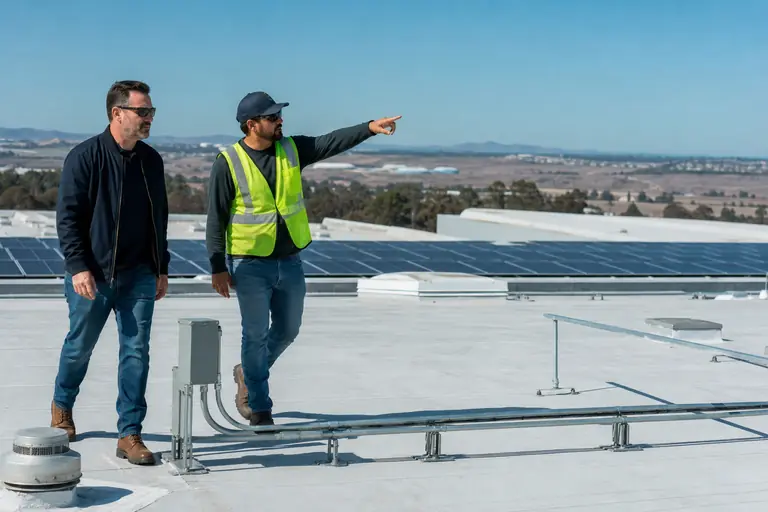
Choose a commercial solar installer in San Diego by checking four things: a valid California contractor license, real commercial experience with SDG&E interconnection, a proposal designed around net billing and your actual usage, and warranties backed by a company that will be around to honor them. Get at least three itemized bids built from the same data, and compare projected bill savings rather than price per watt.
Check the license and credentials first
In California, solar installation requires a license from the Contractors State License Board (CSLB). Installers usually hold a C-10 electrical or C-46 solar license, and some general contractors hold a B license with qualified subs. Look the company up on the CSLB website and check three things:
- The license is active and matches the company name on the bid.
- Workers’ compensation and bond information is current.
- There are no unresolved complaints or disciplinary actions.
Industry credentials help too. NABCEP certification for designers and installers is widely respected. Ask who on the team holds it and whether that person will work on your project.
Look for real commercial experience
Residential and commercial solar are different businesses. Commercial projects involve larger electrical services, structural reviews, three-phase power, demand charges, fire department access paths and more complex SDG&E interconnection under Rule 21. Ask each installer for:
- Three commercial projects in San Diego County of similar size and building type, with contacts you can call.
- How long their recent projects took from contract to permission to operate, and where the delays came from.
- Who handles permitting with the City of San Diego or your local building department.
- Whether they use their own crews or subcontractors, and who supervises on site.
Call the references. Ask whether the system produces what was promised, whether the bills look like the proposal and how the installer handled problems.
Judge the proposal, not the pitch
Under California’s net billing tariff, the value of a system depends on how much power you use on site, hour by hour. A strong proposal shows that. Give every installer the same twelve months of interval data from your SDG&E account, and look for:
- Itemized pricing for equipment, labor, electrical upgrades, roof work, permits and interconnection.
- A production estimate and a self-consumption estimate, with the rate schedule and export values they used.
- A clear bill comparison for summer and winter months, including fixed charges that remain.
- Storage modeled as an option, especially if you have evening use or demand charges.
- Specific equipment models, not “or equivalent.”
If you need a refresher on the rules, our guide to California’s net billing tariff covers how export credits work.
Warranties, service and staying power
Commercial solar systems run for decades. The installer’s warranty is only as good as the company behind it.
- Equipment warranties come from manufacturers and cover panels and inverters. Ask how claims are handled.
- Workmanship warranties come from the installer and cover leaks, wiring and mounting. Get the length and terms in writing.
- Roof penetration warranties matter on commercial roofs. Ask whether your roofer’s warranty stays intact and get that confirmed in writing.
- Monitoring and service should be spelled out: who watches performance, how fast they respond and what it costs after year one.
Ask how long the company has operated in San Diego and who would service the system if it closed.
Spot red flags and compare bids
- A promise that your SDG&E bill will drop to zero.
- Pressure to sign the same day or a “price good only today.”
- A proposal sized to your annual usage with no mention of self-consumption or export values.
- Vague equipment descriptions or no itemized pricing.
- Tax credit claims stated as certain. Federal credits changed significantly in 2025, and only your accountant can tell you what applies.
- No mention of roof condition on an older building.
Good installers welcome hard questions. If a salesperson gets defensive about your interval data or the warranty terms, move on.
Put the bids side by side
Once the bids are in, put them on one sheet. Line up system size, price, projected first-year savings, self-consumption share, equipment models, warranty terms and estimated timeline. Differences that looked small in a sales meeting become obvious in a table. If one bid is far cheaper, find out what it leaves out, such as electrical upgrades, roof work or monitoring. If one is far more expensive, ask what you get for the difference.
Then talk to the finalists about the schedule. Commercial projects in San Diego run through structural review, fire department access requirements and SDG&E interconnection, and each step can add weeks. An installer who gives you a realistic timeline with the reasons behind it is usually more reliable than one who promises the fastest install in the county. Ask what happens if the project slips, and whether the contract has milestones tied to payments.
How chamber membership helps
Looking for member installers? Start at solar and storage companies in San Diego.
Referrals from people who have worked with an installer beat any ad. The San Diego Green Chamber connects you with solar, storage, roofing and electrical companies whose members all commit to reducing energy and water use. Search the Member Business Directory, see how the chamber supports the solar and storage industry and ask peers about their experiences at free networking events co-hosted with San Diego Green Drinks. See how to join.
Questions
What license does a solar installer need in California?
Solar contractors need a license from the Contractors State License Board, usually a C-10 electrical or C-46 solar license. Verify it on the CSLB website before you sign.
How many solar quotes should a business get?
Get at least three itemized quotes built from the same twelve months of SDG&E interval data, then compare projected bill savings rather than price per watt.
How long does commercial solar take in San Diego?
It varies with system size, permitting and SDG&E interconnection. Ask installers how long their recent local commercial projects took and where delays came from.
Will solar void my roof warranty?
It can if penetrations aren’t handled to the roofer’s standards. Ask your installer and roofer to confirm in writing how the roof warranty is protected.
Prove it. Get referred for it.
Join the San Diego Green Chamber to get listed, introduced and referred by businesses that check.