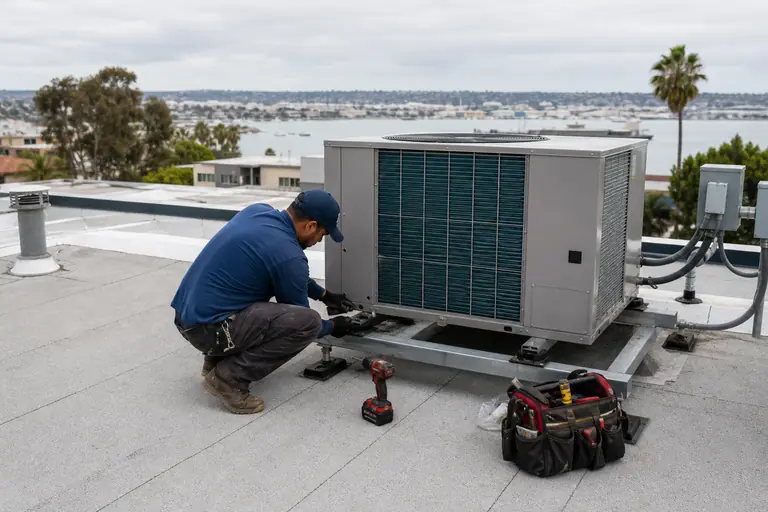
Heat pumps work very well for commercial buildings in San Diego’s coastal climate. Winters are mild and summers are moderate near the coast, so heat pumps run in the conditions where they are most efficient, providing both heating and cooling from one system. The real planning questions are electrical capacity, choosing the right system type for the building, and controls, not whether the equipment can handle the weather.
Why the coastal climate suits heat pumps
A heat pump moves heat rather than making it. In heating mode it pulls heat from outdoor air, and its efficiency drops as outdoor temperatures fall. Along the San Diego coast, winter nights rarely get cold enough to strain modern equipment, so heat pumps can deliver several units of heat for each unit of electricity they use.
That efficiency is what makes the economics work. A gas furnace or boiler can never deliver more heat than the fuel it burns. A heat pump in mild weather routinely does, which offsets the higher price of electricity compared with gas per unit of energy.
Cooling loads near the coast are modest too, thanks to the marine layer. Inland, in places like El Cajon, Santee and Escondido, summers are hotter and cooling dominates. Heat pumps still fit there, but sizing for cooling peaks becomes the bigger design question.
Common commercial heat pump systems
- Packaged heat pump rooftop units. The direct replacement for gas-pack rooftop units on low-rise offices, retail and light industrial buildings.
- Split and ductless systems. Good for small offices, server rooms, additions and spaces with no ductwork.
- Variable refrigerant flow (VRF). Serves many zones from shared outdoor units and suits multi-tenant offices and buildings with mixed loads.
- Heat pump water heaters. Replace gas water heaters for restrooms, kitchens and laundry, and can be scheduled around peak hours.
- Water-source and air-to-water systems. Used in larger buildings with hydronic distribution.
For many small and mid-size San Diego buildings, the simplest path is replacing aging gas-pack rooftop units with heat pump units at the end of their life. Planning ahead keeps you from making a rushed like-for-like gas replacement when a unit fails in July.
Restaurants and food businesses have extra decisions. Heat pump water heaters can handle much of a kitchen’s hot water, but sizing matters because dishwashing and prep create large, short demands. Pairing a heat pump water heater with storage lets it heat water during cheaper hours and draw from the tank at peak. Ask a contractor with kitchen experience to size it.
What to plan for
Electrical capacity
Replacing gas heat with electric heat pumps can add load to your electrical service. Have an electrician or engineer review your panel and service size early. If an SDG&E service upgrade is needed, start that process well ahead, because utility timelines can be long.
Refrigerants
California, through the California Air Resources Board, restricts high global warming potential refrigerants in new equipment, and federal rules are moving in the same direction. Ask your contractor which refrigerant the equipment uses and how that affects service and future parts.
Placement, noise and maintenance
Outdoor units need airflow and service access, and they make some noise. On tight urban lots and mixed-use buildings, check placement against neighbors and local noise rules. Heat pumps also run year-round for heating and cooling, so filter changes, coil cleaning and refrigerant checks matter more than they did on a gas furnace that ran a few weeks a year. Build a maintenance plan into the purchase.
Controls and operating costs
Operating cost depends heavily on your electric rate. On SDG&E’s time-of-use plans, the afternoon and evening on-peak window is the expensive time to run equipment. Smart scheduling, pre-cooling and good thermostats help. Our guide to all-electric buildings in San Diego covers how heat pumps fit into a wider electrification plan.
Code, incentives and next steps
Recent updates to California’s Title 24 energy code have made heat pumps the baseline approach in more building types, which affects new construction and some major alterations. Your designer or contractor should confirm what applies. Check SDG&E and statewide programs for current incentives before you buy, since offerings and terms change.
- List your HVAC and water heating equipment with ages and fuel types.
- Flag units within a few years of end of life.
- Get an electrical capacity review for the building.
- Ask two or three contractors for heat pump options and operating cost estimates on your actual rate.
- Plan replacements in sequence so you are never forced into an emergency decision.
- Measure results after each change by comparing bills for the same months before and after.
Keep records as you go. Equipment lists, bills from before and after each replacement, and the date gas service was reduced or removed give you specific proof of progress. That record helps when customers, tenants or bid reviewers ask what your business has actually done.
Contractors who design and install these systems are part of our energy efficiency and HVAC network.
How chamber membership helps
San Diego Green Chamber members commit to reducing energy and water use, and switching to heat pumps is one of the clearest ways to show progress. Members get education on code and policy changes, a listing in the Member Business Directory, and free networking events co-hosted with San Diego Green Drinks, where building owners meet HVAC contractors, electricians and energy consultants. Learn about membership.
Questions
Do heat pumps work in San Diego winters?
Yes. Coastal San Diego winters are mild, which is where heat pumps run most efficiently. Modern units also handle the cooler nights found in inland and foothill areas.
Will a heat pump raise my electric bill?
It shifts energy from gas to electricity, so your electric bill may rise while gas costs fall. Total cost depends on your rate plan, equipment efficiency and controls, so ask contractors for estimates on your actual rate.
Do I need an electrical upgrade for a commercial heat pump?
Sometimes. Have an electrician review your panel and service before choosing equipment, and start any SDG&E service upgrade early.
Prove it. Get referred for it.
Join the San Diego Green Chamber to get listed, introduced and referred by businesses that check.