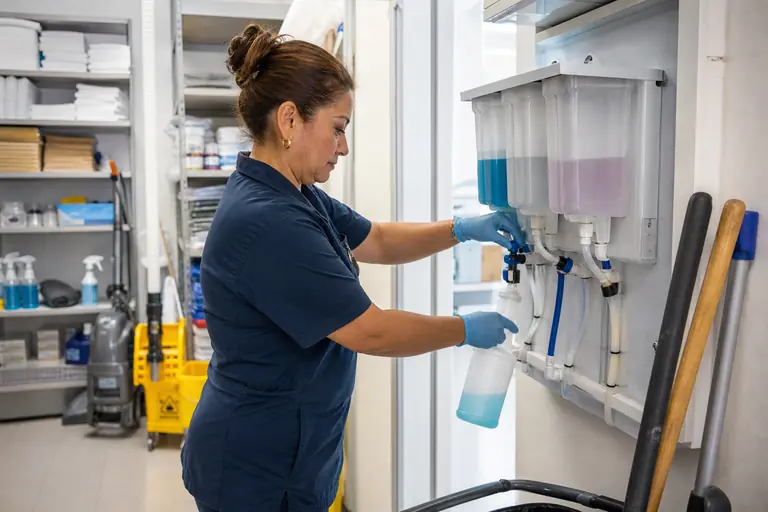
To choose green cleaning products for a commercial space, pick products certified by a credible third party, such as EPA Safer Choice, Green Seal or UL ECOLOGO, use concentrates with a dilution system, and use disinfectants only where they are needed. Check that each product works on your surfaces before switching. That combination cuts health risks for staff and occupants, lowers waste and often lowers cost per use.
Why it matters for your business
Cleaning chemicals affect the people who use them every day and the people who work in the building. Some conventional products contain ingredients that irritate skin, eyes or lungs, and many release volatile organic compounds that affect indoor air. Property managers and tenants increasingly ask cleaning vendors what they use. Some corporate tenants and public agencies write green cleaning requirements into their contracts.
For cleaning companies, a credible green program can win bids. For facility managers, it supports building certifications and occupant health goals. Our guide on indoor air quality in offices covers the air side in more detail.
Labels you can trust
Words like “natural,” “non-toxic” and “eco” on a label mean little on their own. The Federal Trade Commission’s Green Guides warn marketers against broad, unqualified environmental claims. Look for third-party certifications with published standards.
- EPA Safer Choice. The U.S. EPA reviews every ingredient against safety criteria. The program covers many cleaning product categories.
- Green Seal. A nonprofit that sets standards for cleaning products, including its standard for commercial and institutional cleaners, and certifies products and cleaning services.
- UL ECOLOGO. A certification program covering cleaning products and other categories, based on multi-attribute environmental standards.
- EPA Design for the Environment (DfE). A logo for antimicrobial products, such as disinfectants, that meet EPA’s criteria for human health and the environment.
Ask suppliers for the certification number and check it on the certifier’s website. Certifications expire and products change formulas.
Packaging counts too. Concentrates in bulk containers cut plastic, shipping weight and storage space compared with ready-to-use bottles. Ask suppliers whether they take back empty drums or offer refillable containers. Some also sell certified paper towels, toilet tissue and trash liners with recycled content, which rounds out a green cleaning program without adding work for your crew.
Disinfectants need special care
Disinfectants and sanitizers are regulated as pesticides under federal law and must be registered with the EPA. A product that claims to kill germs must carry an EPA registration number on the label. Most general cleaning certifications do not cover disinfectant claims, which is why the DfE logo exists.
Use disinfectants where they matter, such as restrooms, break room surfaces and high-touch points, and follow the label’s dwell time. For floors, glass and general surfaces, a certified cleaner usually does the job. Overusing disinfectants adds cost and exposure without added benefit.
California rules to know
California has some of the strictest rules on cleaning products in the country. The Cleaning Product Right to Know Act requires manufacturers to disclose many intentionally added ingredients on labels and online. CARB’s consumer products regulations limit VOC content in many cleaning product categories. Cal/OSHA’s hazard communication standard requires employers to keep safety data sheets for hazardous chemicals and train workers on them. Requirements change, so check current guidance from the agencies.
Indoor air rules and tenant expectations overlap here. Lower-VOC products help offices that pursue building certifications or report on occupant health, and they reduce complaints about odors after the night crew leaves. In San Diego’s mild coastal climate, many buildings run economizers that bring in outside air, but sealed or older buildings can hold fumes longer, so product choice matters more there.
How to switch without problems
- Inventory what you use now. List every product, where it is used and how much you buy each month.
- Cut the number of products. Many facilities use more products than they need. A short list of certified multi-surface, glass, restroom and floor products covers most work.
- Choose concentrates with dilution control. Wall-mounted dispensers mix the right ratio every time. That cuts overuse, shipping weight and plastic bottles.
- Test before you switch. Try each new product on your actual surfaces and soils for a few weeks. Stone, stainless steel and specialty flooring can react differently.
- Train your crew. Cover dilution, dwell time for disinfectants, safety data sheets and protective equipment. Green products still need correct use.
- Pair products with tools. Microfiber cloths and mops clean well with less chemical and water, and vacuums with good filtration reduce dust.
What it costs
Certified products often cost about the same as conventional ones per use, especially when bought as concentrates. Savings come from fewer products, accurate dilution and less overuse. Track cost per square foot cleaned before and after the switch, along with any change in complaints or worker injuries. Those numbers make a strong case in a bid or a tenant meeting. Cleaning companies on our green cleaning and facilities page use this kind of record to show what they actually do.
How chamber membership helps
San Diego Green Chamber members commit to reducing energy and water use, and a green cleaning program supports that work with less water and fewer chemicals. Membership includes education and resources, a Member Business Directory listing where property managers can find you, and free networking events co-hosted with San Diego Green Drinks, where cleaning companies meet facility managers and suppliers. Learn more on our membership page.
Questions
What is the most trusted green cleaning certification?
EPA Safer Choice, Green Seal and UL ECOLOGO are the most widely recognized for cleaning products. Check the certification on the certifier’s website before you buy.
Are green disinfectants effective?
Disinfectants must be registered with the EPA regardless of how they are marketed. Look for an EPA registration number and, if you want a lower-hazard option, the EPA Design for the Environment logo.
Do green cleaning products cost more?
Not necessarily. Concentrates with dilution control often match or beat conventional products on cost per use, and cutting the number of products reduces overuse.
Prove it. Get referred for it.
Join the San Diego Green Chamber to get listed, introduced and referred by businesses that check.