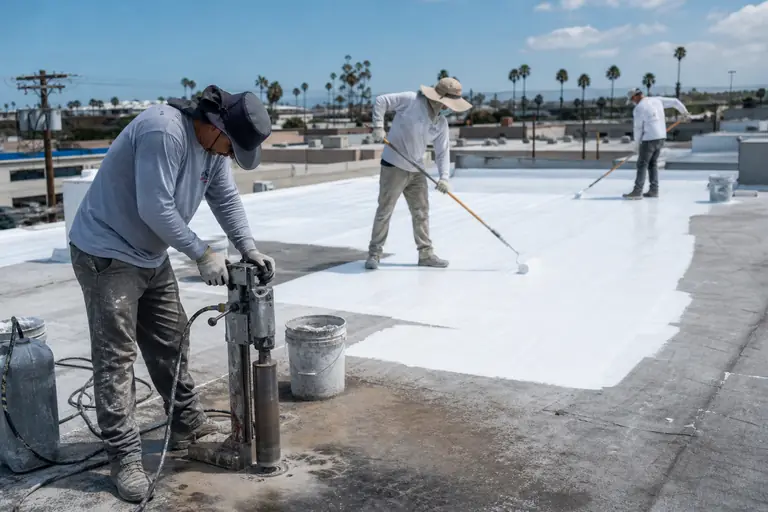
A roof coating is the better choice when the existing roof is structurally sound, mostly dry and failing only at the surface. Replacement is the right call when the insulation is saturated, the deck is damaged or the membrane has reached the end of its life. The honest answer depends on testing, not on a sales pitch. A moisture survey and a few core samples tell you which side of the line your roof is on.
What a coating actually does
Commercial roof coatings are fluid-applied layers, commonly acrylic, silicone or polyurethane, that cure into a continuous membrane over the existing roof. They seal minor cracks and seams, protect the roof from UV, and, in white or light colors, turn a dark roof into a reflective cool roof. Some systems can be recoated later, which extends the cycle again.
What a coating does not do is fix what is underneath. It will not dry out wet insulation, repair a rotted deck or correct poor drainage. Coating over those problems traps them and can void the coating warranty.
Chemistry matters as well. Silicone coatings handle ponding water better than many acrylics, while acrylics are often easier to recoat and can cost less per square foot. Some coatings bond poorly to certain existing roof types without a primer. A contractor should explain why a given product fits your roof, and run an adhesion test on a small area before coating the whole field.
San Diego’s climate is kind to coatings. There is little freeze-thaw cycling, and rain is limited to a short season. Long hours of sun are the main stress, which is why UV resistance and reflectance retention deserve attention when you compare products.
When a coating makes sense
- The roof is a few years from the end of its life but still watertight in most areas.
- A moisture survey shows only a small share of wet insulation, which can be cut out and replaced.
- The deck is solid, with no sagging or rust-through.
- Drainage works, or ponding areas can be corrected before coating.
- You want to avoid the disruption of a tear-off in an occupied building.
- You want a reflective surface to cut cooling loads, especially on an inland building.
Coatings also keep the old roof out of the landfill. A tear-off sends large volumes of material to disposal, and only some roofing materials have good recycling outlets in San Diego County.
When replacement is the right call
- Large areas of saturated insulation, which add weight and lose insulating value.
- Deck damage, corrosion or structural concerns.
- Widespread membrane failure, such as shrinkage, splitting or seams pulling apart.
- Existing layers that already reach what the building code allows, which limits recover options.
- Plans to add solar, when the roof cannot support a 25-year array life even after coating.
A replacement costs more up front and causes more disruption, but it resets the clock and lets you add insulation, improve drainage and fix details properly. For older buildings, that can be the cheaper path over 20 years.
Test before you decide
Any contractor recommending a coating or a replacement should base it on data you can see. A good assessment includes:
- A visual inspection of the field, seams, flashing, drains and penetrations.
- An infrared or capacitance moisture survey to map wet areas.
- Core samples to confirm what is in the roof assembly and how many layers exist.
- A drainage review, including where water ponds after rain.
- A written report with photos and a marked roof plan.
Get the report even if you only collect one bid. It makes comparing options and warranties far easier.
Compare costs and warranties honestly
Prices vary by roof size, condition, access and product, so get written bids. Compare them on the same basis: what is included in prep, how much wet insulation will be replaced, dry film thickness for coatings, and what the warranty actually covers. A coating warranty may cover material only, or material and labor. Some require periodic inspections or maintenance to stay valid.
Also check code. California’s Title 24 includes cool roof requirements that can apply to reroofs and some recover work on nonresidential buildings, depending on scope and climate zone. Our guide to cool roofs for San Diego commercial buildings explains how reflectance and code fit together. Ask your contractor to confirm what applies to your project.
Watch for red flags
Be cautious with any contractor who recommends a coating without testing, promises a coating will fix active leaks everywhere, or quotes a warranty longer than the manufacturer offers. Roofers who sell coatings honestly will tell you when a roof is not a candidate. You can find peers and partners who work this way in our roofing and cool roofs network.
How chamber membership helps
Building owners are wary of roofing claims, and honest comparisons win their trust. San Diego Green Chamber members commit to reducing energy and water use, appear in the Member Business Directory, and can pursue sustainability certification options that show real steps. Members also get education on code changes and free networking events co-hosted with San Diego Green Drinks, where roofers meet property managers and facility teams. See membership details.
Questions
How long does a commercial roof coating last?
It depends on the product, thickness and conditions. Many systems are designed to be recoated at the end of their warranty period, which extends the roof’s life again. Ask for the manufacturer’s warranty terms in writing.
Can a coating stop leaks?
A coating can seal minor surface defects, but leaks from failed flashing, wet insulation or deck damage must be repaired first. Coating over them usually makes things worse.
Is a coating more sustainable than replacement?
Often, because it keeps the existing roof out of the landfill and can add reflectance. That only holds if the roof underneath is sound enough for the coating to last.
Prove it. Get referred for it.
Join the San Diego Green Chamber to get listed, introduced and referred by businesses that check.