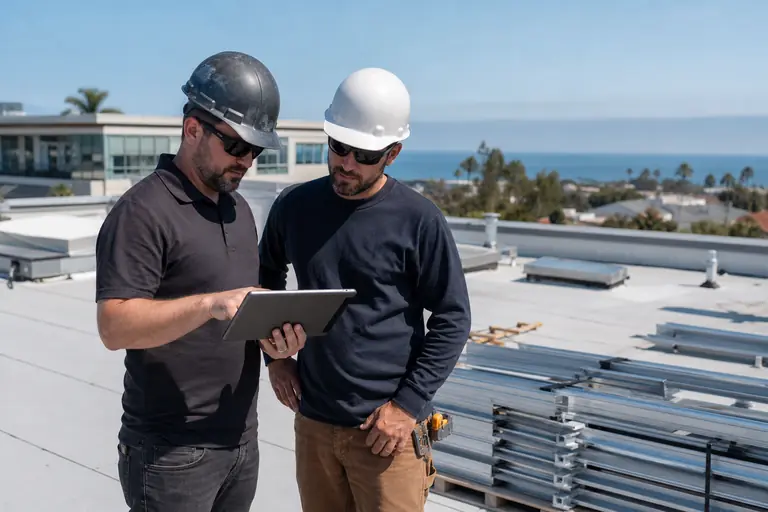
Roofers and solar installers should partner because they sell to the same customer at the same moment. A building owner considering solar needs to know the roof will last as long as the panels, and an owner replacing a roof is often weighing solar. A working partnership turns that overlap into steady referrals, fewer warranty disputes and projects that run in the right order.
The problem a partnership solves
Without coordination, the same story repeats. A solar company installs on a roof with a few years left. The roof fails, the owner calls a roofer, and the roofer has to work around an array, or the panels must come off and go back on. Then comes the argument about whose attachment caused the leak. The customer loses money and trust in both trades.
Building owners increasingly know this risk. Many would rather hire a team that has already worked out the handoffs than manage two contractors who have never met.
Sequencing is the other half of the problem. On a reroof with solar, the roof has to be finished, inspected and documented before racking goes on, and any rooftop HVAC work needs to fit in between. When the two firms plan the schedule together, crews show up in the right order, the customer gets one timeline, and nobody waits on a trade that was not told the date changed.
What each side gains
For roofers
- Reroof and restoration work that solar sales teams find before installation.
- Detach-and-reset jobs, plus flashing and penetration work on new arrays.
- Fewer surprise service calls to diagnose leaks under equipment you did not install.
- A stronger pitch to owners who want a roof that is ready for solar later.
For solar installers
- A trusted partner to assess roof age and condition before you sign the customer.
- Fewer post-install leak claims and warranty disputes.
- Referrals from roofing customers who are replacing a roof and open to solar.
- Faster, cleaner projects when one crew finishes and the other starts on schedule.
How to set up the partnership
- Agree on a roof assessment standard: what the roofer checks, how remaining life is estimated, and what gets reported to the customer.
- Agree on attachment and flashing details for each roof type you both work on, and confirm they meet roof manufacturer warranty requirements.
- Define who does which work. Flashing at attachments is often the roofer’s job; racking and electrical belong to the installer.
- Put responsibility for leaks at attachment points in writing, including how long each side stands behind its work.
- Set a referral process: how leads are passed, how quickly each side responds, and how the customer is kept informed.
- Review jobs together every quarter, look at callbacks and customer feedback, and fix what went wrong before it repeats.
Keep licensing clean. In California, roofing, solar and electrical work fall under different Contractors State License Board classifications, so each firm should only perform work its license covers. If you plan to pay referral fees or bid as a joint team, talk to your attorney about the right contract structure.
Selling the joint offer
The pitch is simple: one assessment, one plan and two trades that already know each other. For commercial owners, a combined proposal can show the reroof or coating, the solar layout and the sequencing on one schedule. For property managers with several buildings, a partnership means one roof survey program that flags which buildings are ready for solar now and which need work first.
A cool roof surface adds to the offer. It lowers cooling loads on its own and gives the array a durable base. Point customers to a clear checklist, such as our guide on whether a roof is ready for solar, so they understand why the roof assessment comes first.
Joint offers also help after the sale. Owners with an array still need roof maintenance, and a roofer who already knows the layout can inspect and repair around it without damaging equipment. Building that service relationship into the offer gives the customer one less thing to manage and gives both firms repeat contact with the account.
Pick partners with care
A partner’s mistakes become your reputation. Before you send customers to anyone, check their license status with the CSLB, ask for references on projects like yours, and visit a finished job. Look for a firm whose standards match yours on safety, workmanship and how they talk to customers. Start with a small number of joint projects and expand from there. Talk openly about capacity, too. A partner who cannot staff your referrals within a reasonable time will cost you customers, however good their work is. Roofers looking for solar partners, and installers looking for roofers, can find aligned firms through our roofing and cool roofs network.
How chamber membership helps
The San Diego Green Chamber exists to create business between members. Roofers and solar installers meet at free networking events co-hosted with San Diego Green Drinks, find each other in the Member Business Directory, and share a baseline commitment: every member commits to reducing energy and water use. That shared commitment makes it easier to find a partner whose standards match yours. See how to join.
Questions
Who should handle flashing on a solar installation?
It depends on the roof warranty and your agreement. Many partnerships have the roofer flash attachments so the roof warranty stays intact, while the installer handles racking and electrical.
Can a roofer refer customers to a solar company for a fee?
Referral arrangements are common, but contract terms and licensing rules matter. Talk to your attorney before setting up paid referrals or joint bids.
What licenses apply to roofing and solar work in California?
Roofing, solar and electrical work fall under different Contractors State License Board classifications. Check the CSLB website to confirm which license covers each part of the job.
Prove it. Get referred for it.
Join the San Diego Green Chamber to get listed, introduced and referred by businesses that check.