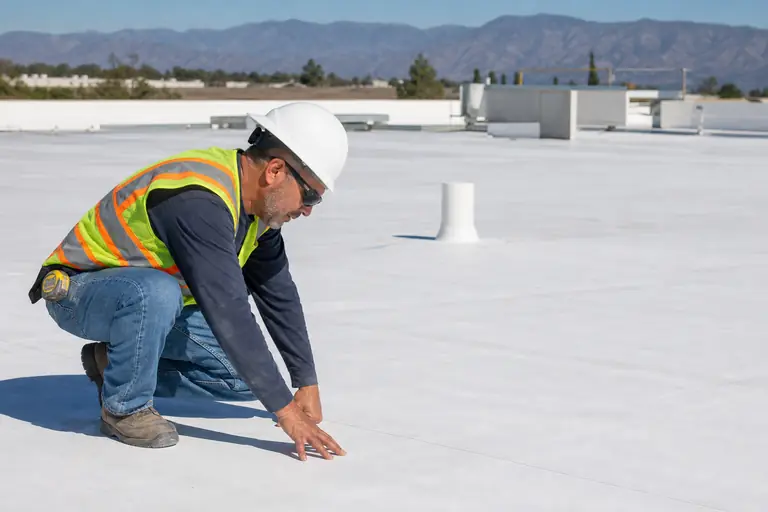
A cool roof is a roof surface built to reflect more sunlight and release absorbed heat quickly, so the building underneath stays cooler. For San Diego commercial buildings, cool roofs lower air conditioning loads, ease peak demand on hot afternoons and can extend roof life. The payoff is largest on inland buildings with big, low-slope roofs and modest insulation, and smaller but still real near the coast.
How a cool roof works
Two properties do the work. Solar reflectance measures how much sunlight the surface bounces back. Thermal emittance measures how well it releases the heat it does absorb. A dark roof on a summer afternoon can run far hotter than the air around it, and that heat moves down into the building and into your cooling bill. A reflective, high-emittance surface stays much closer to air temperature.
The Cool Roof Rating Council (CRRC) rates roofing products for both properties, including aged values after several years of weathering. Ask for the CRRC rated values on any product you consider, and pay attention to the aged numbers. Dirt and weathering lower reflectance over time.
A cool roof works alongside insulation, not instead of it. Insulation slows heat moving through the roof assembly in both directions. A reflective surface cuts how much heat reaches the assembly in the first place. On an older building with little insulation, the reflective surface does more of the work, which is why the savings there tend to be larger. When you replace a roof, adding insulation at the same time is often the cheapest moment to do it, because the old membrane is already off.
There is a side benefit for solar. Rooftop panels produce slightly better when they run cooler, and a reflective roof keeps the air around the array from getting as hot as it would over a dark surface. Treat that as a bonus, not the reason to choose a cool roof.
Where cool roofs pay off in San Diego County
San Diego County spans several California climate zones, and the business case changes with them. A warehouse in El Cajon, Santee or Escondido sees far more cooling hours than an office building a mile from the beach in Oceanside or Pacific Beach. Inland roofs face hotter summers, and that is where a reflective surface cuts the most kWh.
Cool roofs make the strongest case when several of these are true:
- The roof is low-slope and large relative to the building’s floor area.
- The space below is air conditioned, especially single-story warehouses, retail and light industrial.
- Insulation is thin or old.
- The building runs cooling during SDG&E’s afternoon and early evening on-peak hours.
- The roof is due for replacement or recoating anyway, so the extra cost of a reflective surface is small.
Heating penalties, a concern in cold climates, are minor here. San Diego’s mild winters mean the cooling savings usually outweigh any added heating.
Title 24 and cool roof requirements
California’s Title 24 energy code includes cool roof requirements for many nonresidential roofs, and they can apply when you replace or recover a roof, not only on new construction. Whether they apply depends on roof slope, climate zone and the scope of the work. Your roofing contractor or a Title 24 consultant should confirm the requirements before you choose a product, and your local building department will check at permit.
Treat code compliance as the floor. Choosing a product with higher aged reflectance than the minimum can be a low-cost upgrade when you are already paying for a new roof.
Choosing the right cool roof option
Most commercial cool roofs in San Diego fall into a few categories:
- White single-ply membranes such as TPO or PVC, common on new low-slope roofs and full replacements.
- Reflective coatings, typically acrylic or silicone, applied over an existing roof that is still sound.
- Cool-colored products for steep-slope roofs, where a bright white surface is not practical or allowed.
- Reflective cap sheets on built-up and modified bitumen systems.
A coating can turn an aging dark roof into a cool roof without a tear-off, but only if the roof underneath is in good shape. Our guide comparing roof coatings vs replacement walks through that decision.
What to ask before you sign
- What are the product’s CRRC initial and aged reflectance and emittance values?
- Does this scope trigger Title 24 cool roof requirements, and does the product comply?
- How will the roof be cleaned and maintained to hold its reflectance?
- Will glare affect neighbors, skylights or rooftop workers, and how will you handle it?
- Is the roof planned for solar later, and does the system support that?
Also check with SDG&E for any current business efficiency programs before you commit. Program offerings change, so confirm current terms directly. Roofers who want to stand out on these jobs can find peers and partners through our roofing and cool roofs network.
How chamber membership helps
Building owners want a roofer they can trust on performance claims. San Diego Green Chamber members commit to reducing energy and water use, can pursue the chamber’s sustainability certification options, and are listed in the Member Business Directory. Members also get education on code changes and free networking events co-hosted with San Diego Green Drinks, where roofers meet the solar installers, property managers and energy consultants who send referrals. Learn about membership.
Questions
Do cool roofs work in coastal San Diego?
Yes, but savings are smaller near the coast because there are fewer hot hours. Inland buildings in places like El Cajon and Escondido usually see the biggest cooling reductions.
Does Title 24 require a cool roof when I reroof?
It can. Title 24 includes cool roof requirements for many nonresidential reroofs depending on slope, climate zone and scope. Have your contractor confirm before you choose a product.
Do cool roofs stay reflective?
Reflectance drops as roofs get dirty and weather. Look at CRRC aged values when comparing products, and plan for periodic cleaning.
Prove it. Get referred for it.
Join the San Diego Green Chamber to get listed, introduced and referred by businesses that check.