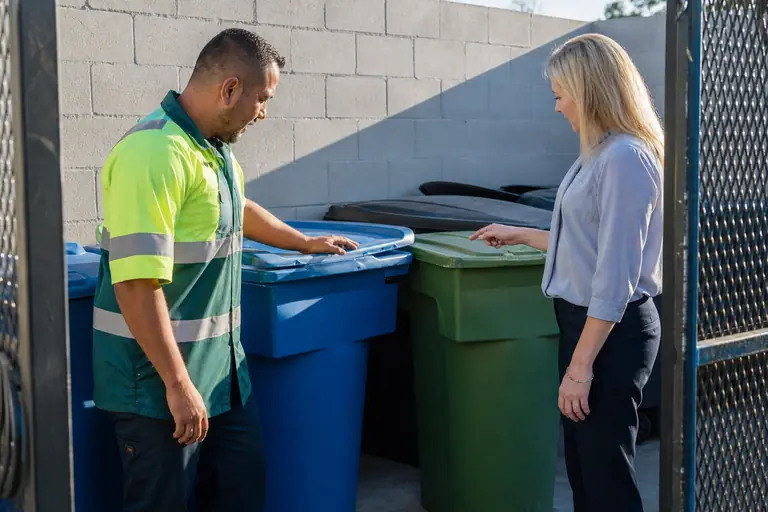
A commercial recycling program works when the containers match the waste you actually produce, every bin is labeled the same way, staff are trained, and someone checks contamination and costs each month. Start with a simple waste audit, set up service with your hauler to match it, and adjust after 60 days. Most failures come from skipping the audit or never checking the bins again.
Know what the law already requires
California requires most businesses to recycle. AB 341 set mandatory commercial recycling, AB 1826 added organics for larger producers, and SB 1383 now requires organics collection for nearly all businesses. Your city adds local rules on top. In the City of San Diego, the Environmental Services Department runs the recycling ordinance, and businesses arrange service through franchised haulers. Most other cities in the county use a franchise hauler, which is where you start.
So the question is not whether to recycle. It is whether your program actually diverts material and keeps costs in check.
Step 1: Audit your waste
You can’t size containers without knowing what you throw away. A basic audit takes an afternoon.
- Pick a typical week and collect one day’s trash, or look in the dumpster before pickup.
- Sort it roughly into cardboard, mixed paper, bottles and cans, plastic film, food and food-soiled paper, and true trash.
- Estimate each category by volume. Photos help.
- Note where each type comes from: the break room, the warehouse, the front counter, the kitchen.
- Pull 12 months of hauler invoices to see container sizes, pickup frequency and any extra charges.
Most businesses find two or three streams make up most of the volume. Warehouses see cardboard and film. Offices see paper and food. Restaurants see food and cardboard. Build the program around those streams.
Step 2: Set up the right service
Take your audit to your hauler and ask for a service review. Ask about container sizes, pickup frequency, what each stream costs, and what the facility they deliver to accepts. Accepted materials vary, and recycling something your hauler’s facility can’t take only adds contamination.
- Right-size the trash container once recycling and organics take material out of it.
- Ask whether a cardboard baler or a compactor makes sense if you generate a lot of one material.
- Check whether plastic film or pallets can go back to a supplier or a specialty recycler.
- Get the service in writing, including any contamination fees.
Space is often the real constraint. Older San Diego buildings have small enclosures built for one trash dumpster. Ask the hauler about smaller carts, more frequent pickup for one stream, or sharing an enclosure with a neighbor. If you lease, bring the property manager in early, because the enclosure, the service account and the rules for tenants usually sit with them.
If cost is your main concern, see our guide on how to reduce your business waste hauling costs.
Step 3: Make the bins impossible to get wrong
People sort by habit and by what’s in front of them. Design for that.
- Pair every trash can with recycling, and organics where food is present. A lone trash can collects everything.
- Use consistent colors: blue for recycling, green for organics, gray or black for trash. State standards are moving this way.
- Label with pictures of the actual items your business throws away, in English and Spanish if your team needs it.
- Put bins where waste is made, not where they look tidy. The packing station needs a cardboard bin, not the lobby.
- Make the janitorial crew part of the plan. If the cleaning crew dumps every bin into one bag, nothing else matters.
Step 4: Train, check and adjust
Train staff at launch and when new people start, in five minutes, at the bins themselves. Then check. Once a week for the first month, look in the recycling and organics containers. Plastic bags, gloves and food in the recycling are the common problems. Fix them at the source with a better label, a moved bin or a quick word with a team lead.
Track a few numbers monthly: container sizes and pickups, total hauling cost, and any contamination notices. A shared spreadsheet is enough. After 60 days, ask the hauler to adjust service. Many businesses can drop a trash pickup or downsize a container at that point, which is where the program starts paying for itself.
Step 5: Tell people what you did
Customers and bid reviewers increasingly ask about waste. Answer with specifics: which streams you separate, how you cut container size, and how you check contamination. Specific claims hold up. “We recycle” does not. Keep the records that back up what you say, including invoices before and after the change, so the claim survives a follow-up question.
How the chamber helps
The San Diego Green Chamber puts you in a room with recycling and waste businesses and with members who have already set up programs, so you can compare notes on haulers, balers and labeling before you spend money. Every member commits to reducing energy and water use, and the chamber offers education and resources on practical operations like this. See what membership includes.
Questions
Is commercial recycling required in San Diego?
Yes. State laws including AB 341, AB 1826 and SB 1383 require most businesses to recycle and to arrange organics collection, and cities add local rules.
What is the first step in setting up a recycling program?
A simple waste audit. Look at what you throw away for a day, sort it into rough categories and use that to size containers with your hauler.
How do we stop contamination in recycling bins?
Pair every trash can with recycling, label bins with pictures of your actual waste, put them where waste is made and check them weekly at first.
Can recycling lower our hauling bill?
Often, once recycling and organics pull material out of the trash and you right-size the trash container. Ask your hauler for a service review after 60 days.
Prove it. Get referred for it.
Join the San Diego Green Chamber to get listed, introduced and referred by businesses that check.