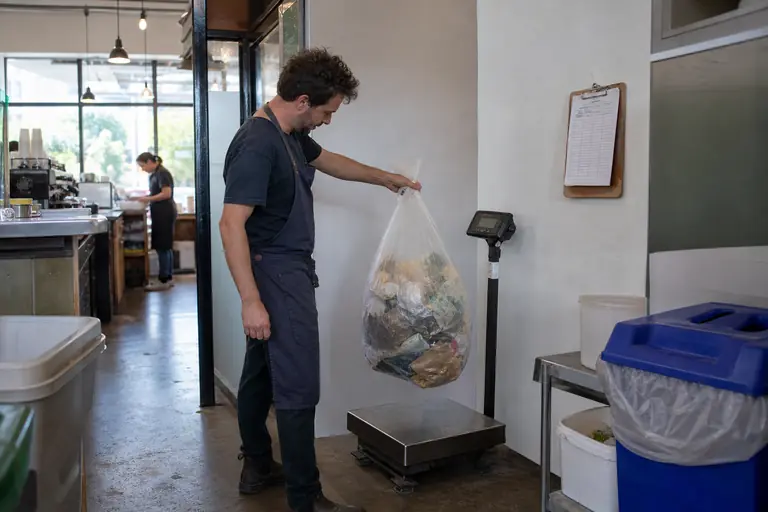
A realistic zero waste goal for a small business is a measured target, such as diverting most of your waste from landfill within two or three years, paired with steps to buy and throw away less. It starts with a baseline, focuses on your two or three biggest waste streams, and gets reported honestly. Very few businesses reach literally zero, and claiming you have is a fast way to look like a greenwasher.
What zero waste means, and what it doesn’t
Zero waste is a hierarchy. Avoid waste first, then reuse, then recycle and compost, and send to landfill only what’s left. Diversion rate (the share of your waste that doesn’t go to landfill) is the common measure, but a business that buys twice as much and recycles all of it hasn’t improved. Watch total waste, not just the percentage.
Third-party programs exist for businesses that want verification. TRUE certification, run by Green Business Certification Inc., is one well-known zero waste standard for facilities. Most small businesses don’t need certification to start, but its structure is a useful guide. The City of San Diego also has a zero waste plan for its own operations and the community, which is worth reading for local context.
Step one: measure a baseline
You need a starting number. You don’t need a lab.
- Pull 12 months of hauler invoices and list container sizes and pickups for each stream.
- Do a one-week waste audit: look inside each container before pickup and estimate how full it is and what’s in it.
- If you can, weigh bags for a week with a floor scale. Weight is more accurate than volume.
- Write down your top five materials by volume or weight and where each comes from.
- Record it all in one spreadsheet with the date. That is your baseline.
This tells you where to focus. A café’s waste is mostly food, cups and milk cartons. A print shop’s is paper and packaging. An office’s is break room waste and paper. A small warehouse is often mostly cardboard, stretch film and pallets.
Also note what you buy. A quick look at your top 20 purchases by volume shows where waste enters the building. Packaging that arrives with every delivery is waste you pay for twice: once in the product price and again in the hauling bill. That list becomes your supplier conversation later.
Set a target you can defend
Pick a target tied to your baseline and a date. Examples: cut trash container volume in half within 12 months, or reach a set diversion rate in two years. Avoid round promises you can’t measure. A target is only useful if you can show progress against it with records.
Remember that some of this is already required. SB 1383 requires organics collection for nearly all businesses, and state law requires commercial recycling. Our guide to SB 1383 organics recycling covers those rules. Compliance gets you part of the way. Your zero waste plan goes further.
Fix the biggest streams first
Work from the top of your list down, using the hierarchy.
- Avoid: ask suppliers for less packaging, returnable crates or bulk delivery. Switch to digital receipts and invoices. Stop buying single-use items you don’t need.
- Reuse: use refillable containers, reusable service ware for dine-in, durable shipping totes and pallets that go back to the vendor.
- Recycle: set up labeled bins that match what your hauler accepts, and keep contamination low.
- Compost: send food scraps and food-soiled paper to organics collection, and donate surplus edible food.
- Find specialty outlets: e-waste, batteries, lamps and some plastics need specific recyclers. Line those up instead of letting them pile up.
Buy with the end in mind. Before you choose a product, ask what happens to it and its packaging when you’re done. Procurement decisions drive most of your waste.
Run it like a business process
Expect the first year to bring the biggest gains. Moving food and cardboard out of the trash often cuts volume quickly. After that, progress comes from slower work: supplier changes, reuse systems and finding outlets for odd materials. Plan for both phases so a slower second year doesn’t look like failure.
Assign one owner. Review the numbers monthly at first, then quarterly. Train staff when they start and remind them when something changes. Check bins weekly for the first few months. Share progress with the team, since people sort better when they see results.
When you talk about it publicly, be specific: what you measured, what changed, and what’s still going to landfill. “We cut our trash pickups from three a week to one by composting food scraps” is a claim customers believe. “We’re a zero waste business” invites the question of how you prove it, and many businesses can’t. A plan you show with real numbers is more credible than a slogan, and it holds up in a bid review.
How the chamber helps
The San Diego Green Chamber gives you a network of recycling and waste businesses and peers working on the same goals, so you can find the right hauler, reuse vendor or specialty recycler through people you trust. Every member commits to reducing energy and water use, and the chamber offers education, resources and sustainability certification options for businesses ready to document progress. See what membership includes.
Questions
Can a small business really be zero waste?
Very few reach literally zero. A realistic goal is a measured reduction and a high diversion rate over a set time, with honest reporting on what still goes to landfill.
How do we measure our waste?
Start with a year of hauler invoices and a one-week audit of what’s in each container. Weighing bags with a floor scale for a week improves accuracy.
What is a diversion rate?
The share of your waste kept out of landfill through reuse, recycling and composting. Track total waste too, since buying more and recycling it isn’t progress.
Do we need zero waste certification?
Not to start. Programs like TRUE certification add third-party verification, which some businesses pursue once their program is working.
Prove it. Get referred for it.
Join the San Diego Green Chamber to get listed, introduced and referred by businesses that check.