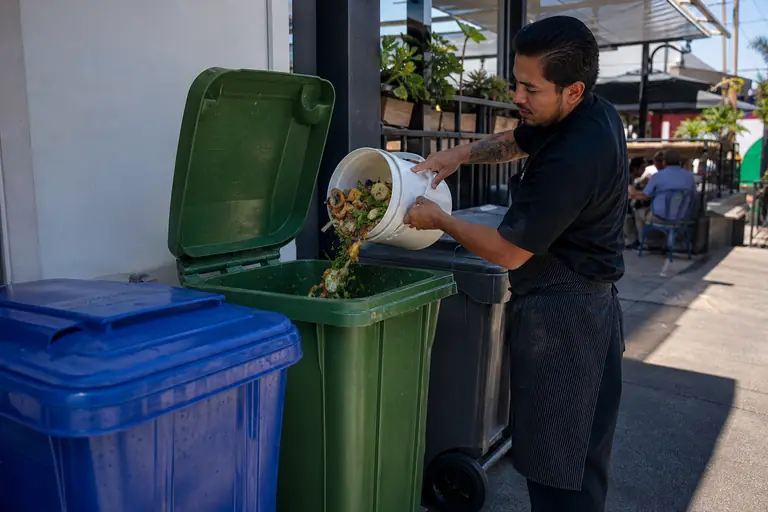
SB 1383 requires San Diego businesses to separate organic waste (food scraps, food-soiled paper and yard trimmings) from trash and send it to organics collection, either through their hauler or by self-hauling to an approved facility. Larger food businesses must also donate surplus edible food to food recovery organizations and keep records. Your city or hauler enforces it, and enforcement is already in effect.
What SB 1383 is
SB 1383 is a 2016 California law aimed at cutting methane from landfills, where buried food and yard waste breaks down without oxygen. CalRecycle wrote the regulations, and they took effect in 2022. They put duties on cities and counties, on haulers, and on businesses. For a business owner, the practical result is a new service line, new bins and a few new habits.
It builds on earlier state laws. AB 341 already required many businesses to recycle, and AB 1826 required larger organic waste producers to arrange organics service. SB 1383 extends the organics requirement to nearly all commercial businesses and adds edible food recovery.
What most businesses must do
- Subscribe to organics collection through your hauler, or self-haul organics to a facility that accepts them and keep records. Some jurisdictions grant waivers for very low volumes or lack of space, but you have to apply.
- Provide labeled containers for organics and recycling wherever you provide trash containers for employees, and in customer areas where your business generates the waste. Color and labeling standards are phasing in, with green for organics, blue for recycling and gray or black for trash.
- Train employees on what goes in each container, at least once a year and when new staff start.
- Check for contamination regularly. Plastic film, gloves and packaging in the organics cart can lead to rejected loads and fees.
- Cooperate with inspections from your city or hauler, including container checks and record requests.
If you share an enclosure with other tenants, the property owner usually arranges service and must give tenants containers and information. Talk to your landlord or property manager so everyone knows who is responsible.
Edible food donation for larger generators
Some food businesses are “commercial edible food generators.” The regulations sort them into two tiers. Tier 1 covers businesses such as supermarkets, larger grocery stores, food distributors and wholesale food vendors, and their requirements began in 2022. Tier 2 covers businesses such as large restaurants, hotels with on-site food service, health facilities, large venues and events, and schools, with requirements that began in 2024. The tiers have size thresholds, so check the CalRecycle definitions or ask your city which tier, if any, applies to you.
Covered generators must:
- Arrange to donate the maximum amount of surplus edible food that would otherwise be thrown away.
- Sign a written agreement with each food recovery organization or service that collects or receives it.
- Keep records of what was donated, to whom and how often.
- Make records available when the city or county asks.
Food donors acting in good faith have liability protection under state and federal law. Talk to your attorney if you have specific concerns, and ask your jurisdiction which local food recovery organizations it works with.
How it works in San Diego County
Each city sets local rules and runs enforcement. In the City of San Diego, commercial businesses get service through franchised private haulers, and the Environmental Services Department handles the city’s organics rules, outreach and inspections. Most other cities in the county contract with a franchise hauler that serves both homes and businesses. In every case, the hauler can tell you what organics service costs and what goes in the cart, since accepted materials vary by facility.
Jurisdictions were required to begin enforcement, and penalties are now possible for businesses that don’t comply after notices. The cheapest path is to get compliant before the inspector visits. Restaurants have the most to manage, so we wrote a separate guide on organics recycling for San Diego restaurants.
Keeping the cost down
Organics service is a new line on the bill, but it doesn’t have to be a net increase. Food scraps are heavy, and once they leave the trash, many businesses can reduce trash container size or pickup frequency. Ask your hauler for a service review after the first month of organics collection. Cutting food waste at the source, through better ordering, portioning and prep, shrinks every container at once.
Keep simple records: your service agreement, invoices, training dates and any waiver. If an inspector asks, a folder with those documents ends most conversations quickly.
A short checklist covers most businesses:
- Confirm organics service is on your hauler account, or document your self-haul destination.
- Put labeled organics and recycling containers next to every trash can staff use.
- Hold a five-minute training at the bins and log the date.
- Check the organics cart weekly for plastic and gloves.
- Find out whether you are a Tier 1 or Tier 2 edible food generator.
How the chamber helps
Running a kitchen? See how to run organics recycling in a restaurant kitchen.
The San Diego Green Chamber connects businesses with recycling and waste companies and with peers who have already set up organics programs, so you can ask what worked before you pay for it. Members commit to cutting energy and water use, and waste is part of the same operational discipline. The chamber also offers education and a unified voice on policy questions that affect local businesses. See what membership includes.
Questions
Does SB 1383 apply to small businesses?
Yes, in most cases. Nearly all commercial businesses must have organics collection or self-haul, though some jurisdictions grant waivers for very small volumes or lack of space. Ask your city or hauler.
What counts as organic waste under SB 1383?
Food scraps, food-soiled paper and yard trimmings are the main materials. Accepted items vary by facility, so check with your hauler.
Who has to donate edible food?
Tier 1 and Tier 2 commercial edible food generators, such as supermarkets, distributors, large restaurants, hotels and large venues. Size thresholds apply.
Who enforces SB 1383 in San Diego?
Your city or the county, depending on where you are. CalRecycle oversees how jurisdictions carry it out.
Prove it. Get referred for it.
Join the San Diego Green Chamber to get listed, introduced and referred by businesses that check.