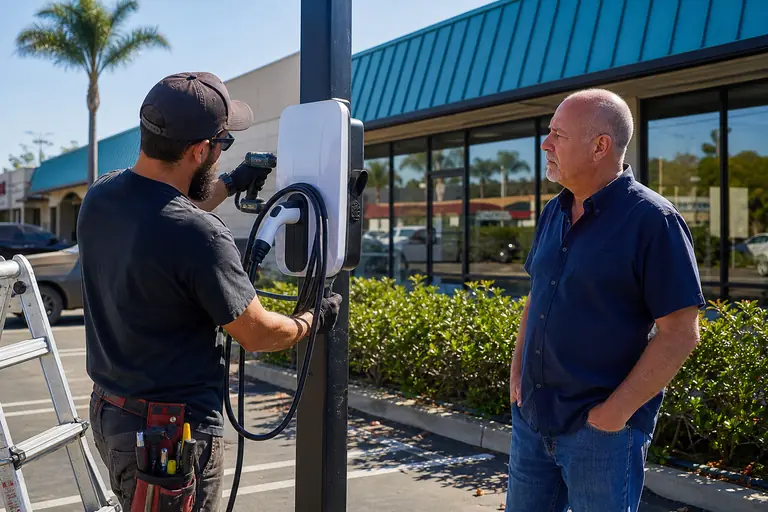
California businesses can look for EV charger incentives in five places: their utility (SDG&E in San Diego), their community choice energy provider, state programs from the California Energy Commission and CARB, the local air district, and credit programs such as California’s Low Carbon Fuel Standard. Federal tax incentives were cut back in 2025. Programs open, close and change often, so check current terms and get approval before you buy equipment.
Why timing matters
Most charger incentives have rules about when you apply. Many require approval or a reservation before you buy chargers or start construction, and some fund only specific equipment from approved lists. Others pay out in rounds that fill quickly. Buying first and applying later is the most common way businesses miss out. Build the incentive search into the start of your project, not the end.
Incentives also shape design choices. A program may fund only networked chargers, require a set number of ports or cap payment per port. Knowing those rules early lets your electrician design a project that qualifies instead of redesigning it later. It also helps you compare offers from installers, since some bundle incentive paperwork into their service and some leave it to you.
Where to look
SDG&E
SDG&E has run several programs to help businesses install charging, including programs that pay for or share the cost of make-ready infrastructure (the wiring and electrical work up to the charger) for workplaces, multi-family properties and fleets. It also offers commercial EV rate options. Check SDG&E’s business EV pages or ask your account representative which programs are currently open.
Community choice providers
San Diego Community Power serves the City of San Diego and several other cities and unincorporated areas, and Clean Energy Alliance serves cities such as Carlsbad, Escondido, Oceanside, San Marcos and Vista. Community choice providers have offered their own clean energy and EV programs at times. If you are a customer, check their sites.
California Energy Commission
The CEC funds charging through programs such as CALeVIP, which has run regional rebate rounds for public and workplace chargers, and EnergIIZE, aimed at medium- and heavy-duty fleet infrastructure. Rounds open and close, and each has eligibility rules for location, equipment and use. Watch the CEC’s announcements for new funding.
CARB and the San Diego County Air Pollution Control District
CARB’s programs focus mostly on vehicles, such as HVIP vouchers for zero-emission trucks and vans, but some fleet programs include charging. The San Diego County Air Pollution Control District has administered state grant funds for cleaner vehicles and related infrastructure. Check the district’s grant pages for open solicitations.
Low Carbon Fuel Standard credits
Under CARB’s Low Carbon Fuel Standard, the electricity dispensed through EV chargers can generate credits that can be sold. Charger owners, or the charging network acting for them, may earn ongoing revenue this way. Credit values move with the market, so treat it as a bonus rather than a sure thing. Ask your charger provider who claims the credits under your contract.
Federal incentives
The federal tax credit for business charging equipment (section 30C) ended under 2025 federal legislation for property placed in service after June 30, 2026. Check with your accountant before you assume any federal credit applies to your project.
How to search efficiently
- Define the project: number and type of chargers, location, who will use them (employees, fleet, public) and target install date.
- Search the U.S. Department of Energy’s Alternative Fuels Data Center laws and incentives database, filtered for California.
- Check SDG&E, your community choice provider, the CEC, CARB and the air district directly. Note deadlines and pre-approval rules.
- Ask your charger installer which programs they have recently used. Experienced installers often know which rounds are open.
- Confirm whether incentives can be combined. Some programs restrict stacking.
- Get written approval or a reservation before ordering equipment, if the program requires it.
- Keep every invoice, photo and inspection record. Payouts often require them.
Common requirements to expect
- Chargers from an approved equipment list, often networked.
- Minimum operating periods, sometimes several years, with use data reported.
- Public access or specific hours if the program funds public charging.
- Accessibility compliance and permits from your city or the county.
- Installation by a licensed contractor, sometimes with specific electrician training.
Read the obligations before you accept funds. A program that pays well but requires public access may not suit a secured employee lot. Ask what happens if a charger is removed or the business moves before the operating period ends, since some programs require repayment. If your project is for workplace parking, our guide on workplace EV charging for San Diego businesses covers the planning side.
How chamber membership helps
Incentive programs change faster than most businesses can track. The San Diego Green Chamber offers education on topics like this one and a unified voice on policy, and it connects you with charger installers and EV companies whose members all commit to reducing energy and water use. Search the Member Business Directory, see how the chamber supports the EV and clean tech industry and ask peers which programs worked for them at free networking events co-hosted with San Diego Green Drinks. Learn about membership.
Questions
Are there EV charger rebates for San Diego businesses?
Programs have been offered by SDG&E, community choice providers, the California Energy Commission and the local air district. Availability changes, so check each source for open programs.
Can I apply for an incentive after installing chargers?
Often not. Many programs require approval or a reservation before you buy equipment or start work. Check the rules before you order.
What are LCFS credits for EV charging?
Under CARB’s Low Carbon Fuel Standard, electricity dispensed for EV charging can generate tradable credits. Values change with the market, so ask your charger provider who claims them.
Is there still a federal tax credit for business EV chargers?
Not for new installations. 2025 federal legislation ended the business charger credit for property placed in service after June 30, 2026. Ask your accountant what applies to your project.
Prove it. Get referred for it.
Join the San Diego Green Chamber to get listed, introduced and referred by businesses that check.