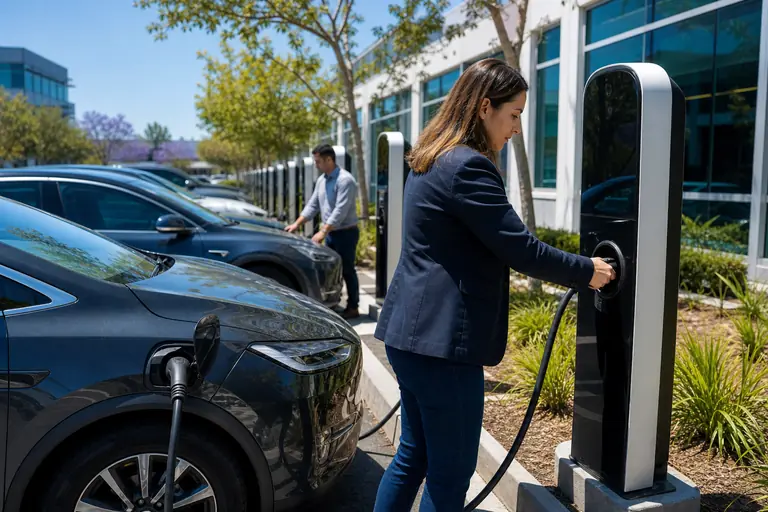
Workplace EV charging for most San Diego businesses means a handful of Level 2 chargers in the employee or visitor lot, sized to your electrical capacity and managed so they don’t spike your SDG&E demand charges. Plan the electrical work first, check accessibility and permit rules, decide whether drivers pay and choose networked chargers you can control. Done well, charging helps with hiring, keeps commuting employees happy and gives you something specific to report.
Why businesses add workplace charging
San Diego County has a large and growing number of electric vehicles, and many employees who live in apartments or condos can’t charge at home. Charging at work solves that problem for them, which makes it a real recruiting and retention perk. It also signals to customers and visitors that your sustainability commitment includes something concrete.
For some properties, charging is also a requirement. California’s CALGreen code requires new nonresidential construction, and some additions and alterations, to include EV-capable parking spaces and installed chargers. If you are building or renovating, ask your architect what applies.
Level 2 or fast charging
- Level 2 chargers run on 208 or 240 volts and add range over several hours. Employees who park for a full workday rarely need more. They cost far less to install and run than fast chargers.
- DC fast chargers add significant range in under an hour. They suit fleets, retail and quick-turn parking, but they need much more electrical capacity and can drive up demand charges.
- Level 1 outlets (standard 120-volt) can work for plug-in hybrids or employees with short commutes, at very low cost.
For a typical office, warehouse or medical building, Level 2 is the right answer. If you also run delivery vehicles or service vans, see our guide on how to electrify a small business fleet, since fleet charging needs different planning.
Plan the electrical and the bill
Electrical capacity usually sets the size and cost of a project. Older buildings may need panel or service upgrades, and trenching across a parking lot is often the biggest line item. Before you buy anything:
- Have a licensed electrician assess your service size, panel capacity and the distance from the panel to the parking spaces.
- Pull your SDG&E interval data to see how close you already run to your peak demand.
- Ask about load management, which shares available power among chargers so you can install more ports without a bigger service.
- Check SDG&E’s commercial EV rate options and whether a separate meter for chargers makes sense. Rates and programs change, so confirm current terms with SDG&E.
- Install conduit for future chargers now if you are already trenching. It costs far less than coming back later.
If your building has solar, midday charging puts more of your own solar to work, which matters under California’s net billing tariff.
Permits, accessibility and public use
Charger installations need an electrical permit from the City of San Diego or your local building department. California’s building code also includes accessibility requirements for EV charging spaces, covering the number of accessible spaces, their size and their location. Your electrician or designer should handle this, but confirm it is in the plan.
If you open chargers to the public, more rules apply. California has requirements for how public chargers accept payment, display pricing and report reliability. Check current rules with the California Energy Commission and CARB before you open chargers to visitors or customers.
Set a clear policy for drivers
Charging goes smoothly when everyone knows the rules. Decide and write down:
- Who can use the chargers: employees, visitors, tenants or the public.
- Whether drivers pay, and how. Networked chargers let you set prices, collect payment and track use.
- Time limits and etiquette, such as moving the car when charging finishes.
- Who handles problems, such as a broken charger or an access dispute.
- How you will measure use, so you know when to add more ports.
Free charging is a generous perk, but it can have tax implications for employees. Ask your accountant how to treat it. Many businesses charge a modest rate that covers electricity and keeps spots turning over.
Choose hardware with care. Networked chargers that support open communication standards such as OCPP let you switch software providers later instead of being locked into one vendor. Ask about warranty length, uptime guarantees and who comes out when a charger fails.
Start smaller than you think and plan to grow. A business with a few EV drivers today can install two or four ports, run conduit for more and add capacity as demand rises. Track sessions and energy use from the start. Those numbers tell you when to expand, and they give you a specific, documented result to put in your sustainability reporting and bids instead of a general claim.
How chamber membership helps
Workplace charging brings together electricians, charger providers and property owners. The San Diego Green Chamber connects those businesses, and every member commits to reducing energy and water use. Find EV and electrical companies in the Member Business Directory, see how the chamber supports the EV and clean tech industry and ask peers what worked for them at free networking events co-hosted with San Diego Green Drinks. Learn about membership.
Questions
What kind of EV charger does a workplace need?
Most workplaces need Level 2 chargers, because employees park for hours. DC fast chargers suit fleets and quick-turn retail parking but cost far more to install and run.
Will EV chargers raise my SDG&E bill?
They can, especially through demand charges. Load management, smart scheduling and the right rate plan help. Check SDG&E’s current commercial EV rate options.
Do I need a permit to install EV chargers?
Yes. Charger installations need an electrical permit from your city or the county, and accessibility requirements apply to EV charging spaces.
Should I charge employees to use workplace chargers?
Many businesses charge a modest rate to cover electricity and keep spaces turning over. Free charging may have tax implications, so ask your accountant.
Prove it. Get referred for it.
Join the San Diego Green Chamber to get listed, introduced and referred by businesses that check.