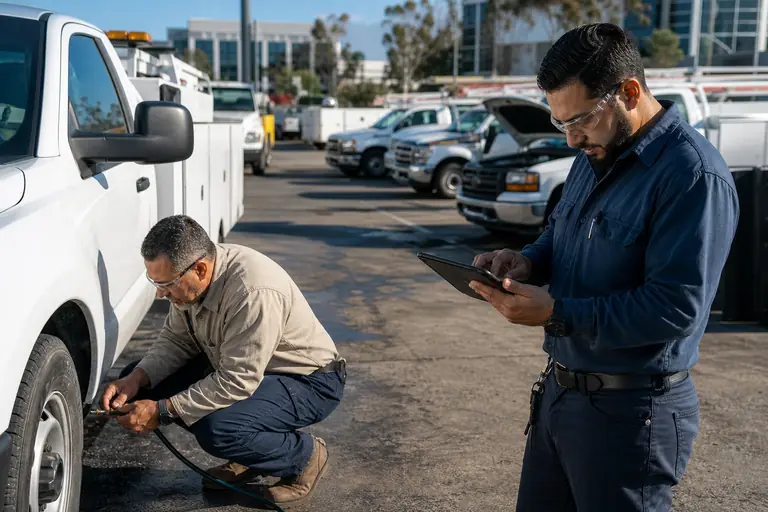
The most reliable ways to cut fleet fuel costs are to measure fuel per mile for each vehicle, cut idling, keep tires and maintenance on schedule, drive fewer miles through better routing, and match each vehicle to the job. For San Diego fleets paying some of the highest fuel prices in the country, these steps often save more than any single new vehicle. Once the basics are in place, electric or hybrid replacements can cut costs further.
Start by measuring
You cannot manage what you do not track. Most small fleets know their monthly fuel bill but not which vehicles or drivers drive it. Fix that first.
- Use fuel cards tied to each vehicle. Cards record gallons, price and odometer readings at the pump. Many also flag unusual purchases.
- Calculate fuel per mile. Divide gallons by miles for each vehicle every month. Compare similar vehicles doing similar work.
- Add telematics if you run more than a few vehicles. GPS units report idling time, harsh braking, speeding and routes. The data shows where fuel goes.
- Set a baseline. Record three months of data before you change anything, so you can prove what worked.
Outliers tell you where to look. A van using far more fuel than its twin usually has a maintenance problem, a driving habit or a route that needs attention.
Watch fuel purchases as well as fuel use. Set card limits by vehicle and fuel type, block purchases outside work hours if that fits your operation, and review exceptions monthly. Shopping for price matters less than people think, but filling up at stations along the route, rather than detouring, saves both fuel and drive time.
Cut idling
An idling engine burns fuel while moving nothing. Crews often idle to keep the cab cool in summer, run tools or wait at job sites. In San Diego’s inland areas, summer heat makes this more common.
California already limits idling. CARB’s commercial vehicle idling rule restricts diesel vehicles over 10,000 pounds gross vehicle weight rating to five minutes in most situations, with some exceptions. Even for lighter vehicles that the rule does not cover, a clear company policy saves money.
- Write an idling policy with a time limit and the allowed exceptions.
- Use telematics reports to show each driver their idle time each week.
- Consider auxiliary power or battery systems for crews that need to run equipment at stops.
- Park in shade where you can, and use sunshades to reduce the need for air conditioning on return.
Keep vehicles in shape
Maintenance is a fuel issue. Underinflated tires increase rolling resistance, and the U.S. Department of Energy notes that keeping tires properly inflated improves fuel economy. Dirty air filters on older vehicles, worn spark plugs, misaligned wheels and the wrong motor oil grade all add up.
Put tire checks on a weekly schedule rather than waiting for a warning light. Follow manufacturer service intervals, and use the oil grade the manufacturer specifies. Remove weight that does not need to ride along. Old inventory, spare parts and unused racks add load on every trip. Roof racks and ladders add drag at freeway speed, so remove them when not needed.
Drive fewer and smarter miles
The cheapest mile is the one you do not drive. Better scheduling and routing cut miles directly. Group jobs by area, avoid sending two vehicles to the same neighborhood on the same day, and plan around peak traffic on I-5, I-15 and I-805 where possible. Our guide to route planning to cut miles and emissions covers the tools and steps in detail.
Driving habits matter too. Hard acceleration and braking, plus high freeway speeds, raise fuel use. Driver coaching works best when it is fair and based on data. Share results, recognize the most efficient drivers and keep it about cost, not blame.
Right-size the fleet
Many small fleets carry vehicles bigger than the work requires. A full-size pickup doing a job a compact van could do burns fuel every day. Review each vehicle’s real use.
- Look at average payload and cargo volume, not the heaviest job of the year. Rent for rare heavy jobs.
- Find underused vehicles. A truck that runs two days a week may be cheaper to sell.
- When a vehicle comes due for replacement, compare hybrid and electric options against gas on total cost of ownership.
Electric vans and trucks have no fuel bill at all, only electricity, which can be much cheaper when you charge off-peak on an SDG&E business EV rate. California’s HVIP program has offered point-of-sale vouchers on eligible zero-emission commercial vehicles. Confirm current funding and rates before buying. Fleets on our clean transportation and logistics page often start with one electric vehicle on a predictable route and expand from there.
Turn savings into proof
Fuel savings are also emissions reductions, since every gallon of gasoline or diesel not burned avoids its carbon dioxide. Keep your before and after numbers in gallons and miles. When a customer, bid or partner asks what you do on sustainability, a record showing fewer gallons per job is far more convincing than a logo on the side of a truck.
How chamber membership helps
Every San Diego Green Chamber member commits to reducing energy and water use, and fuel is energy. Membership includes education and resources on fleet programs and rules, a Member Business Directory listing and free networking events co-hosted with San Diego Green Drinks, where you can compare notes with other fleet operators and meet telematics, charging and vehicle providers. Learn more about membership.
Questions
What is the fastest way to lower fleet fuel costs?
Cutting idling and fixing tire pressure usually deliver quick savings at little cost. Track fuel per mile by vehicle so you can see which changes work.
Does California limit truck idling?
Yes. CARB’s commercial vehicle idling rule generally limits diesel vehicles over 10,000 pounds GVWR to five minutes of idling, with some exceptions. Check CARB for current details.
Is telematics worth it for a small fleet?
For fleets with more than a few vehicles, telematics often pays for itself through lower idling, better routing and earlier maintenance alerts. Ask vendors for monthly pricing and contract terms before signing.
Prove it. Get referred for it.
Join the San Diego Green Chamber to get listed, introduced and referred by businesses that check.