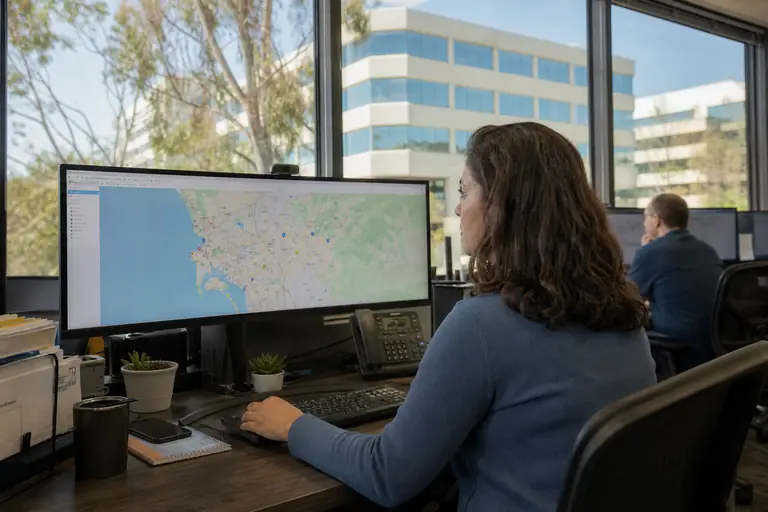
Route planning cuts miles and emissions by grouping stops by area, ordering them efficiently and scheduling around traffic, so each vehicle drives less to do the same work. Most San Diego delivery and service businesses can start with zone-based scheduling and a basic routing tool, then measure miles per stop to prove the result. Fewer miles mean lower fuel or charging costs, less vehicle wear and lower emissions at the same time.
Why routing matters in San Diego
San Diego County is large and spread out. A single day can take a technician from Oceanside to Chula Vista and out to El Cajon. Freeways like I-5, I-15, I-805 and SR-94 carry heavy peak traffic, and coastal routes slow down on summer weekends. Unplanned routes lose time and fuel in exactly these places.
Customers feel it too. Late arrivals and wide arrival windows cost repeat business. Good routing improves on-time performance while it cuts miles, so the case is not only environmental.
Drive time is also paid time. A technician stuck in traffic between two distant jobs is a wage cost with no revenue attached. Many service businesses find that tighter routes let each crew fit one more job into the day, which is often worth more than the fuel saved. For delivery businesses, fewer miles per stop can delay the need to buy another vehicle as volume grows.
Start with your own data
Before buying software, look at what you already have.
- Pull a month of jobs or deliveries. List addresses, time windows, job length and the vehicle that handled each one.
- Map them. Even a free mapping tool will show clusters and crisscrossing. Many owners are surprised by how often two vehicles visit the same area on the same day.
- Calculate miles per stop. Use odometer readings or telematics. This becomes your baseline.
- Note fixed constraints. Some customers need morning arrivals, some loading docks close early, and some jobs need a specific technician or vehicle.
Practical routing methods
You do not need a complex system to get most of the benefit. These methods work for small fleets.
- Zone days. Divide the county into zones, such as North County coastal, North County inland, Central, East County and South Bay, and serve each zone on set days. Offer customers the next available day in their zone.
- Cluster first, then sequence. Group stops by area, then order each group to avoid backtracking.
- Schedule around peaks. Put stops near congested corridors outside rush hours where time windows allow.
- Load to match the route. Load vehicles in reverse stop order and confirm parts or products before leaving, so nobody drives back to the shop.
- Cut failed trips. Confirm appointments the day before. A missed delivery means driving the same route twice.
When to add routing software
Once you run more than a few vehicles or dozens of stops a day, routing software usually pays off. These tools take stops, time windows, vehicle capacity and driver shifts, then produce optimized routes. Many connect with telematics, dispatch and customer notifications. Compare tools on ease of use for dispatchers, how they handle same-day changes, and monthly cost per vehicle. Run a trial on real routes and compare miles per stop to your baseline.
Software only works if the inputs are right. Clean up customer addresses, record realistic job durations and keep vehicle capacities current. Dispatchers should still review the plan each morning, since they know about the customer who always runs late or the site where parking takes ten minutes.
Routing for electric vehicles
If your fleet includes electric vans, routing also decides whether a vehicle finishes its day with charge to spare. Assign electric vehicles to routes that fit comfortably within their real-world range, keeping a cushion for hills, heat and payload. Plan returns to base so vehicles charge overnight off-peak, when SDG&E business EV rates are usually lowest. Some routing tools now account for charge levels directly.
Measure and report the savings
Track miles per stop, fuel or electricity per stop and on-time arrivals each month. Compare against your baseline. Every gallon of fuel you avoid cuts both cost and carbon dioxide emissions, and you can estimate emissions using standard factors published by the U.S. EPA.
These numbers belong in your bids and customer conversations. A statement that miles per delivery fell after you reorganized routes is specific and believable. Pair it with the steps in our guide on practical ways to cut fleet fuel costs for a full picture. Businesses on our clean transportation and logistics page can show this kind of data to customers who care about how goods arrive.
Getting drivers on board
Drivers and technicians know the roads, the shortcuts and the customers. Ask for their input when you redesign zones, and let them flag routes that look good on a map but fail in practice, such as a stop with no parking near a busy Gaslamp storefront or a site that only opens its gate at certain times. Explain the goal in cost and time terms. Share results so people see the effect of their work.
How chamber membership helps
San Diego Green Chamber members commit to reducing energy and water use, and fewer miles means less energy burned. Membership includes education and resources, a Member Business Directory listing and free networking events co-hosted with San Diego Green Drinks, where you can meet logistics providers, software vendors and other fleet operators. Explore our membership options.
Questions
How much can route planning save?
Results vary by fleet, territory and how routes were planned before. Measure miles per stop for a month, then compare after changes to see your actual savings.
Do small businesses need routing software?
Not always. Zone days and simple clustering work well for small fleets. Software tends to pay off once you run several vehicles or many stops a day.
Does route planning reduce emissions?
Yes. Fewer miles mean less fuel burned, which cuts carbon dioxide and other tailpipe emissions. For electric vehicles, fewer miles also cut electricity use.
Prove it. Get referred for it.
Join the San Diego Green Chamber to get listed, introduced and referred by businesses that check.