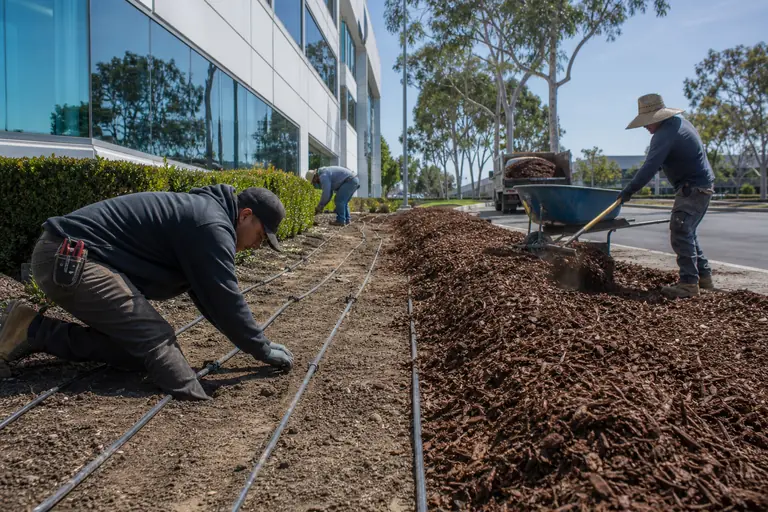
Turf replacement means removing lawn that nobody walks or plays on and replacing it with climate-appropriate plants, mulch and efficient irrigation. For San Diego commercial properties it usually cuts outdoor water use sharply, lowers mowing costs and prepares the site for California’s AB 1572, which phases out watering nonfunctional turf with drinking water at commercial, industrial and institutional properties. Plan the project around rebate pre-approval and the cool-season planting window.
What AB 1572 means for your property
AB 1572 targets nonfunctional turf: grass that is purely decorative, such as street-side strips, medians, parking lot islands and lawn around office buildings. Turf that people actually use for recreation, events or play is treated differently. The law phases in over several years by property type, starting with government-owned properties in 2027, and local water agencies handle much of the enforcement and outreach.
The practical takeaway is simple. If your site has decorative lawn on drinking water, it has a limited future. Replacing it on your own schedule, with rebates available, beats a rushed project later. Confirm the current compliance dates for your property type with your water agency or the California Department of Water Resources, since implementing rules and dates can shift.
Owners and tenants should talk early. In a multi-tenant building the landlord usually controls the landscape and the irrigation meter, but tenants pay for it through common area charges. A tenant asking for a replacement can point to lower operating costs and state compliance. An owner can fold the project into capital planning and mention the lower water use in leasing materials.
Plan the project in the right order
- Map the turf. Measure each area, note its use, sun exposure and slope, and mark which areas are truly functional.
- Check rebates first. Programs through SoCal Water$mart, the San Diego County Water Authority or your local agency may require an application and approval before any grass comes out.
- Design for the site. Coastal sites with marine layer and inland sites with summer heat need different plant palettes and watering plans.
- Convert the irrigation. Replace spray heads with drip or high-efficiency nozzles and add a weather-based controller.
- Remove the turf. Choose a removal method that fits your timeline and soil.
- Plant, mulch and establish. Expect extra watering for the first one to two seasons, then scale back.
Larger projects that need a permit may also fall under the state’s Model Water Efficient Landscape Ordinance or a local version of it, which sets water budgets for rehabilitated landscapes. Your landscape designer should know whether it applies.
Design choices that hold up
Good commercial turf replacement looks intentional, not abandoned. Use a mix of shrubs, groundcovers and a few structural plants so the space reads as planted even when some species go dormant in late summer. California natives and Mediterranean-climate plants both work well here. Leave clear walkways, keep sightlines open for security and signage, and avoid planting tall shrubs where they block drivers at driveways. If staff actually use a patch of lawn for lunch breaks or events, consider keeping it, since turf that people use is treated differently from decorative turf.
Think about stormwater as well. Removing lawn is a chance to add bioswales, permeable paths or shallow basins that let rain soak in rather than run off into storm drains. That helps with local stormwater rules and keeps more water in your soil. For plant ideas suited to the region, see our guide to native, drought-tolerant landscaping.
A note on artificial turf
Artificial turf removes the water bill but adds other costs. It gets very hot in inland sun, needs periodic cleaning and replacement, and offers no habitat or stormwater benefit. Many rebate programs exclude it. Check program rules before you assume it qualifies.
Removal methods and timing
Sheet mulching smothers the grass under cardboard and mulch. It is cheap and builds soil, but it takes several months to work, which suits sites that can wait. Sod cutting removes the grass quickly and suits projects on a tight schedule, though it removes topsoil and creates material to haul away. Ask your contractor how the removed sod will be handled, since green material can often be composted rather than landfilled.
Fall is the best time to plant in San Diego. New plants root during the cooler, wetter months and need less water to get through their first summer. Starting removal in late summer and planting in October or November is a common pattern.
Hiring and managing the work
Use a licensed landscape contractor. In California that usually means a C-27 license, which you can verify with the Contractors State License Board. Ask for photos and water data from similar commercial jobs, a written irrigation plan, a plant warranty and a maintenance plan for the first year. Make sure your ongoing maintenance crew understands the new design. Many replaced landscapes fail because a crew shears native shrubs into boxes or keeps the old watering schedule.
Track results the same way you would any capital project. Compare irrigation meter readings for the same months before and after, and record maintenance hours saved. Contractors in our water efficiency and landscaping network can help you set up that tracking from day one.
How chamber membership helps
San Diego Green Chamber members commit to reducing energy and water use, and turf replacement is one of the most visible ways to follow through. Membership connects you with local landscape and irrigation professionals, education on programs like these, a Member Business Directory listing and free networking co-hosted with San Diego Green Drinks. Learn about membership.
Questions
What counts as nonfunctional turf?
Generally, grass that is purely ornamental and not regularly used for recreation, events or play, such as medians, street strips and lawn around office buildings. Check your water agency’s definitions for your property type.
Do I need approval before removing turf to get a rebate?
Many programs require pre-approval, and work started before approval may not qualify. Apply and confirm terms before removing any grass.
When is the best time to plant after turf removal?
Fall is ideal in San Diego. Plants root during the cooler, wetter months and handle their first summer better.
Does artificial turf qualify for rebates?
Many programs exclude it. Read the current program rules before choosing artificial turf.
Prove it. Get referred for it.
Join the San Diego Green Chamber to get listed, introduced and referred by businesses that check.