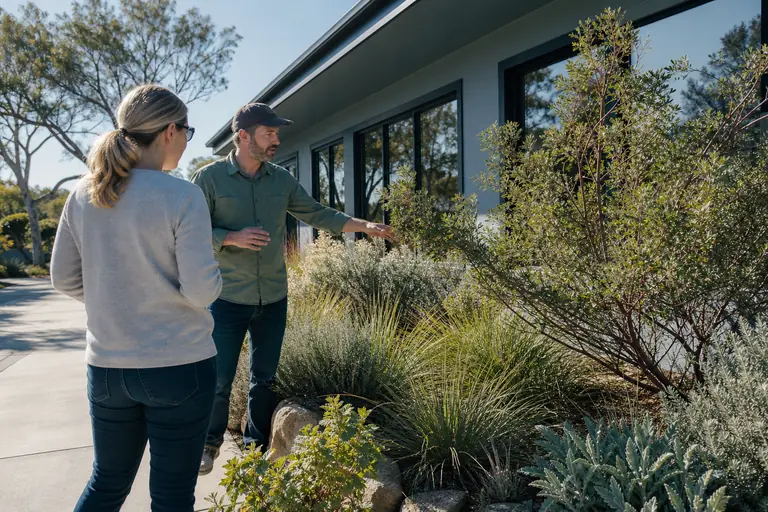
Native and drought-tolerant landscaping uses plants adapted to San Diego’s dry summers and mild, wet winters, so they need far less water and upkeep than lawn and thirsty ornamentals once established. For a business, that means lower water bills, fewer maintenance hours and a site that looks planted year-round. The keys are choosing plants for your climate zone, planting in fall, watering correctly through establishment and training your crew to maintain them properly.
Why natives make business sense
San Diego has a Mediterranean climate. Most rain falls between November and March, and summers are long and dry. Plants from the region’s coastal sage scrub and chaparral communities evolved for exactly that pattern. Once their roots are established, many need little or no summer water. Lawn and tropical plantings need the opposite: steady water through the driest months.
The savings add up beyond water. Native plantings need less mowing, less fertilizer and fewer chemical treatments. They support local pollinators and birds, and they give a property a sense of place that generic corporate landscaping doesn’t. For customer-facing businesses, a well-kept native garden is a visible sign that you follow through on sustainability rather than just talking about it.
Choose plants for your part of the county
Coastal sites from Oceanside to Imperial Beach get marine layer, salt air and mild temperatures. Inland valleys such as El Cajon, Escondido and Ramona see hotter summers, cooler winter nights and occasional frost. Plant choices should match. Common, proven choices for commercial sites include:
- Shrubs: manzanita, California lilac (ceanothus), toyon, lemonade berry and coffeeberry.
- Sages and perennials: Cleveland sage, black sage, California buckwheat and penstemon.
- Grasses and grass-like plants: deer grass and California fescue for texture and movement.
- Groundcovers: low-growing ceanothus and other spreading natives for slopes and large beds.
- Mediterranean-climate companions: plants from similar climates, such as rosemary or lavender, which pair well with natives and are widely available.
Calscape, run by the California Native Plant Society, lets you search plants by address and see which species suit your location. Local nurseries that specialize in natives can also advise on what performs well in your area.
Check mature size before you buy. Shrubs sold in small containers can grow large, and crowded plants end up sheared, which defeats the purpose. Soil matters too. Much of the county has clay or decomposed granite, and most natives do fine in it without heavy amendments, which can hold too much water around the roots.
Plan for fire safety
Much of San Diego County sits in or near wildland areas, and fire safety should shape the design. Keep the area closest to buildings lean: hardscape, gravel or low, well-watered plants rather than woody shrubs and bark mulch. Space larger shrubs apart, remove dead material, and avoid planting under eaves or next to vents. California is developing stricter ember-resistant rules for the few feet immediately around buildings in high fire hazard areas. Check current requirements with CAL FIRE and your local fire agency before finalizing a design.
Planting, irrigation and establishment
- Plant in fall. October through December lets roots grow during the cool, wet season.
- Use drip or low-flow irrigation. Group plants by water need so each zone can be scheduled correctly.
- Water deeply, then less often. New plants need regular water for the first one to two dry seasons. After that, many natives want only occasional deep watering, and some prefer none in summer.
- Mulch. A few inches of mulch keeps soil cool and holds moisture, though keep it away from plant crowns and away from buildings in fire-prone areas.
- Program a smart controller. Weather-based controllers cut water as plants establish and seasons change.
Overwatering kills more natives than drought does. Many species rot in soggy soil, especially in summer. If you are replacing a lawn, convert the irrigation at the same time rather than letting spray heads water the new beds. Our guide to smart irrigation controllers explains how to set zones up properly.
Maintenance and costs
Native landscapes are lower maintenance, not no maintenance. They need light pruning at the right season, weed control while they fill in and occasional replacement of short-lived plants. The biggest risk is a crew trained on lawns and hedges shearing natives into tight shapes, which weakens them and ruins the look. Write native-appropriate practices into your maintenance contract.
Expect a transition period. A native planting takes a couple of years to fill in, and some species look dormant in late summer. Tell staff and regular customers what to expect. A small sign explaining the planting can turn a brown-looking August bed into a conversation about how the business saves water.
Upfront costs depend on site size, soil prep and irrigation changes. Rebates through SoCal Water$mart and programs promoted by the San Diego County Water Authority have helped businesses fund lawn conversions, and the Water Authority has offered landscape classes. Programs change, so confirm current terms. Designers and contractors in our water efficiency and landscaping network handle these projects across the county.
How chamber membership helps
Members of the San Diego Green Chamber commit to reducing energy and water use, and a native landscape is a measurable, visible way to do it. Membership offers education and resources, networking with local landscape professionals, a Member Business Directory listing and free events co-hosted with San Diego Green Drinks. See membership options.
Questions
Do native plants need any water in San Diego?
Yes, while they establish, usually for the first one to two dry seasons. After that, many need only occasional deep watering and some prefer none in summer.
When should a business plant a native landscape?
Fall is best. Planting from October through December lets roots grow during the cooler, wetter months.
Are native plants fire safe?
No plant is fireproof. Keep the area nearest buildings lean, space shrubs, remove dead material and follow current CAL FIRE and local fire agency guidance.
Where can I find natives suited to my site?
Calscape from the California Native Plant Society lets you search by location, and native plant nurseries can advise on local performance.
Prove it. Get referred for it.
Join the San Diego Green Chamber to get listed, introduced and referred by businesses that check.