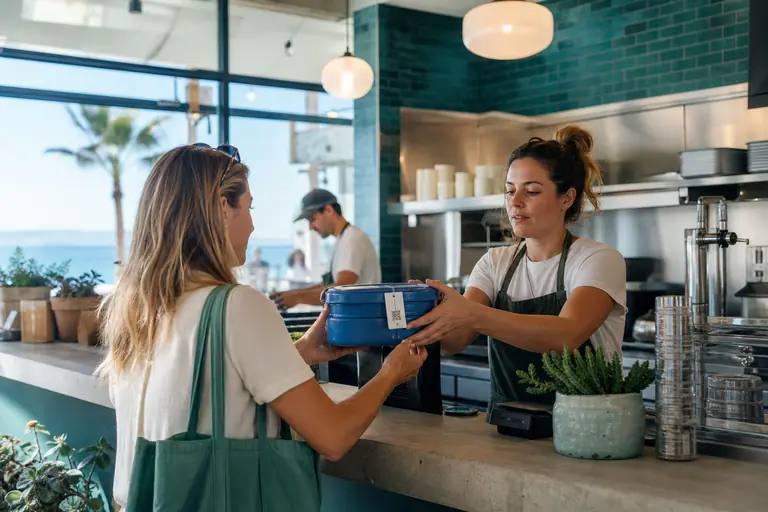
A reusable takeout program replaces single-use to-go containers with durable ones that customers return to be washed and used again. It works when return rates are high, washing meets health code and the program fits your service flow. Most San Diego restaurants start with a small pilot, either running it in-house or joining a third-party reuse service.
Why restaurants are looking at reuse
Single-use packaging is a steady cost that rises with every order. California is also tightening rules on packaging. SB 54 set up an extended producer responsibility program for single-use packaging and plastic foodware, and AB 1276 already requires restaurants to provide single-use utensils, straws and condiment packets only on request. Some cities in San Diego County have their own foodware ordinances. Rules and timelines keep shifting, so check your city’s current requirements.
Customers notice too. A visible reuse option can set you apart, especially with office lunch crowds and regular customers who order several times a week.
Three ways to run a program
- In-house deposit system. You buy containers, charge a deposit or require a sign-up, and wash returns in your own dish machine. You keep full control, but you handle tracking, storage and lost containers.
- Third-party reuse service. A company supplies containers, tracks them through an app or QR code and may collect and wash them. You pay a per-use or monthly fee. Availability in San Diego changes, so check who currently serves your area.
- Bring your own container. Customers bring clean containers for you to fill. It costs almost nothing to start, but volume tends to stay small.
Groups of nearby restaurants sometimes share one reuse system, which makes returns easier for customers. Business districts and food halls are natural places to try it.
Pick the model by your order mix. A dine-in heavy restaurant with a small lunch takeout trade can run a deposit system with little extra work. A delivery-heavy kitchen faces a harder problem, since containers leave with third-party drivers and customers rarely walk back to return them. For delivery, a third-party service with drop points around the neighborhood or a pickup option tends to work better than asking customers to come back to your door. Start where returns are easiest, then expand.
Health code rules
The California Retail Food Code allows reusable containers when they are designed for repeated use and properly cleaned and sanitized. A 2019 change to state law, AB 619, made it easier for restaurants to fill customer-provided containers, provided the food worker handles them in a way that prevents contamination. The County Department of Environmental Health and Quality inspects restaurants in most of the county and can explain what it expects.
Before launch, confirm three things with your inspector or a food safety consultant. First, that your containers are food-grade and dishwasher rated. Second, that your dish machine or three-compartment sink reaches the required sanitizing levels. Third, how you will separate dirty returns from clean stock so they never cross.
Running a pilot
- Pick one menu segment. Start with items that suit a standard container, such as bowls or salads. Avoid items with sauces that stain or odors that linger.
- Choose your model and containers. Get samples. Test them through your dish machine for a week to check durability and drying time.
- Set the incentive. A deposit, a small discount or a loyalty reward on return all work. Deposits usually raise return rates.
- Make returns easy. Put a clearly marked return bin near the door. If you share a system with neighbors, list the other return points.
- Train staff on handling. Returns go straight to the dish area. Clean containers are stored covered and away from dirty ones.
- Track every container. Count containers out and back each week. Return rate is the number that decides whether the program pays.
Costs and the break-even math
A reusable container costs much more than a disposable one, so it has to be used many times to break even. Your real cost per use includes the container, washing labor, water, energy, detergent and losses. Compare that to what you spend now on disposables for the same items.
Washing adds load to your dish area. If your dish machine is old, energy and water costs per cycle may be higher than you think. Our guide to energy-efficient commercial kitchens covers dish machine efficiency. Return rate drives everything. A program with low returns is just an expensive way to give away containers, so set a target and review it monthly.
Telling customers about it
Keep the message simple and specific: how to join, where to return and what they get. Share real numbers once you have them, such as containers reused per month. Avoid vague claims about saving the planet. Restaurants featured on our sustainable food and restaurants page do best when they show what changed.
How chamber membership helps
The San Diego Green Chamber brings together restaurants, packaging suppliers and reuse service providers in one network. Membership includes education and resources on rules like SB 54, a Member Business Directory listing and free networking events co-hosted with San Diego Green Drinks, which are a good place to find neighbors willing to share a return system. Every member also commits to reducing energy and water use. Learn more on our membership page.
Questions
Are reusable takeout containers allowed under California health code?
Yes, when they are designed for repeated use and properly cleaned and sanitized. Confirm your setup with the County Department of Environmental Health and Quality before launch.
Can customers bring their own containers to a restaurant?
California law allows restaurants to fill customer-provided containers if staff handle them in a way that prevents contamination. Restaurants can choose whether to offer it.
What return rate does a reusable program need?
It depends on container cost and washing expense. Calculate your cost per use and compare it to current disposable spending, then set a return target and track it weekly.
Prove it. Get referred for it.
Join the San Diego Green Chamber to get listed, introduced and referred by businesses that check.