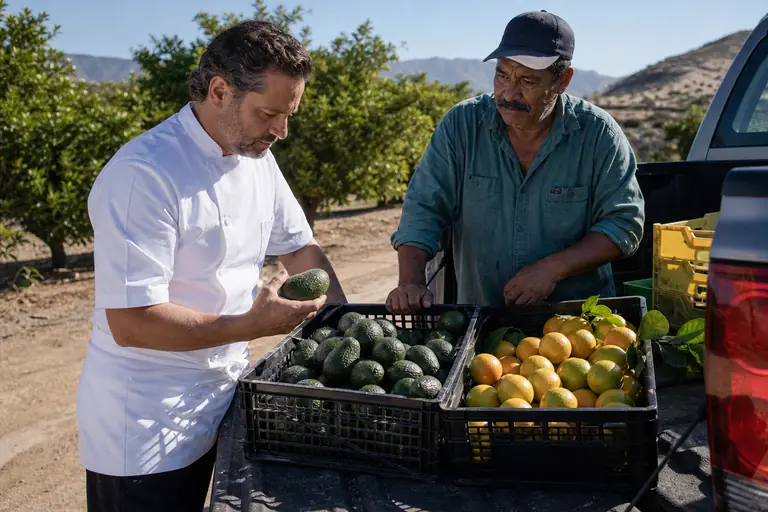
Sourcing local food in San Diego County means buying directly from county farms, fishers and producers, or through distributors that track where products come from. Start with a few high-impact items, such as produce, eggs or seafood, buy only from approved sources, and keep invoices that name the farm. That gives you a better menu story and proof to back it up.
What San Diego County grows and lands
The county has a large number of small farms, many of them family operations in North County and the inland valleys. Avocados and citrus are well known, and the region also produces nursery crops, specialty vegetables, herbs, berries, eggs and some ranching. Coastal and inland growers face different conditions, so availability shifts by area and season.
Seafood is a strong local category. San Diego’s commercial fishers land species that change through the year, and the harbor has hosted a dockside market where fishers sell directly. Local aquaculture, including shellfish, adds another option. Ask suppliers what is in season rather than building a menu around a fixed list.
Where to buy
Each channel has trade-offs in price, reliability and paperwork.
- Direct from farms. Best price per item and the strongest story. You handle ordering, pickup or delivery windows, and variable supply.
- Local food hubs and specialty distributors. They aggregate several farms, deliver on a schedule and invoice like a normal vendor. You pay a margin for the convenience.
- Broadline distributors with local lines. Easiest to add to an existing order. Ask for farm-level origin on the invoice, not just a region.
- Certified farmers’ markets. Good for small volumes and building relationships. Prices are retail, so markets work better for testing than for steady supply.
- Fishers and dockside sellers. Freshest product, but you need to handle receiving, temperatures and traceability properly.
Food safety and approved sources
The California Retail Food Code requires restaurants to buy from approved sources. In practice that means a licensed or registered producer, a certified producer at a certified farmers’ market, or a source that meets the inspection rules for that product type. Eggs, meat, shellfish and dairy carry their own rules. Shellfish in particular must come from certified sources with proper tags, which you must keep on file.
The County Department of Environmental Health and Quality inspects retail food facilities and can tell you what documentation it expects. The County Agriculture, Weights and Measures department oversees certified farmers’ markets and producer certificates. Before your first direct order, ask the farm for its registration or certificate and keep a copy with your receiving records.
Receiving matters as much as buying. Check temperatures on delivery, especially for seafood, eggs and dairy, and log them. Label product with the farm name and date so staff rotate it correctly. If a farm delivers in its own vehicle, agree on drop times and who signs for the order, since a crate left at the back door on a hot inland afternoon is a food safety problem and a cost. A short written spec for each item, covering size, ripeness and packaging, prevents most disputes before they start.
Making the numbers work
Local food often costs more per pound. It can still pay for itself when it cuts waste or supports a higher menu price. Use these steps to test it.
- Pick two or three anchor items. Choose ingredients that customers notice and that hold well, such as citrus, greens, eggs or a seasonal fish.
- Compare usable yield, not sticker price. Fresher produce often lasts longer in the walk-in and trims less. Track waste for a few weeks.
- Build seasonal specials. Specials let you buy what is abundant at a good price without reprinting the full menu.
- Agree on standing orders. Farms plan around reliable buyers. A weekly standing order often earns better pricing and first pick.
- Price the story. Name the farm on the menu where it is true. Diners will pay for a specific source more readily than for a vague “local” label.
Less waste is part of the case. Our guide to restaurant food waste reduction shows how to measure what you throw away, which makes the yield comparison above much easier.
Proving a local claim
“Locally sourced” is a marketing claim, and the Federal Trade Commission and California consumer protection law treat misleading claims seriously. Keep the claim specific and true. Say “tomatoes from a farm in Valley Center” when that is accurate, and drop it when you switch suppliers. Keep invoices that list the farm name. If only part of a dish is local, say which part.
This matters for bids too. Corporate caterers, hotels and event clients increasingly ask how vendors source. A file of invoices and farm certificates answers that question in minutes. Food businesses on our sustainable food and restaurants page compete on exactly this kind of proof.
How chamber membership helps
The San Diego Green Chamber connects businesses that care about measurable sustainability, and that includes food producers, distributors and the restaurants that buy from them. Membership includes a listing in the Member Business Directory, education and resources, and free networking events co-hosted with San Diego Green Drinks, where many supplier relationships start with a conversation. Every member also commits to reducing energy and water use. See our membership options.
Questions
Can a restaurant buy produce directly from a farmer in California?
Yes, as long as the farm is an approved source under the California Retail Food Code. Ask for the farm’s registration or certified producer certificate and keep a copy with your receiving records.
Is local food always more expensive?
Often it costs more per pound, but better shelf life, lower trim loss and higher menu prices for named sources can close the gap. Track yield and waste for a few weeks before deciding.
Can I call my restaurant farm-to-table?
Only if your sourcing supports it. Keep the claim specific, name the farms you actually use and update menus when suppliers change.
Prove it. Get referred for it.
Join the San Diego Green Chamber to get listed, introduced and referred by businesses that check.