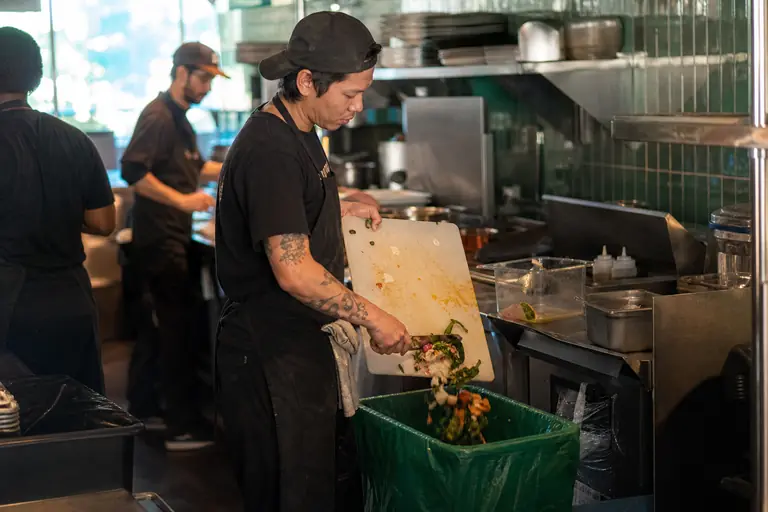
Every San Diego restaurant must keep food scraps and food-soiled paper out of the trash and send them to an organics recycling service, under California’s short-lived climate pollutant law, SB 1383. Larger restaurants also have to donate surplus edible food to a food recovery organization and keep records of it. The practical work is a kitchen bin setup, the right hauler service and a simple paper trail.
For the legal requirements that apply to every business, see SB 1383 organics recycling requirements.
What SB 1383 requires from restaurants
SB 1383 set statewide targets to cut organic waste sent to landfills and to recover edible food for people. CalRecycle wrote the regulations, and each city and the County enforce them locally. For a restaurant, the duties fall into three buckets.
- Separate organics. Food scraps, coffee grounds and food-soiled paper go in the organics stream, not the trash. Your jurisdiction sets which container color and materials apply.
- Subscribe to service. You need organics collection from your hauler, or a documented alternative such as self-hauling to an approved facility. Some jurisdictions allow waivers for very low volumes or space limits, but you have to apply.
- Train and label. Staff need to know what goes where, and containers need clear labels. Inspectors look for contamination in the bins.
Edible food donation is a separate duty. CalRecycle groups generators into tiers. Tier 1 covers grocery stores, supermarkets and food distributors. Tier 2 includes larger restaurants, defined by seat count or square footage, plus hotels with food service above a room threshold, large venues and some institutions. Check CalRecycle’s current tier definitions to see whether your restaurant qualifies.
Setting up the kitchen so it actually works
Most organics programs fail at the prep table, not the dumpster. If the green bin is ten steps away and the trash can is under the counter, scraps end up in the trash. Put organics collection where the scraps are made.
- Map your waste points. Walk the kitchen during prep and service. Note where trimmings, plate scrapings, grounds and soiled paper towels are created.
- Place small bins at each point. Use lidded containers sized to be emptied every shift. Line them with liners your hauler accepts. Not every program takes compostable plastic bags, so ask.
- Color-code and label with pictures. Pictures beat words in a multilingual kitchen. Show your own menu items, such as tortilla scraps, citrus rinds and coffee filters.
- Keep trash harder to reach than organics. One trash can per station is enough. Small changes in placement shift behavior fast.
- Assign an owner per shift. One person checks bins for contamination before they go out. Plastic gloves, wrap and portion cups are the usual problems.
Front of house matters too. Bussing stations need an organics bin for plate scrapings. If you run counter service with customer-facing bins, expect more contamination and plan for staff to sort before collection.
Working with your hauler
In the City of San Diego, businesses contract with franchised private haulers for commercial collection. Other cities in the county, such as Chula Vista, Escondido and Oceanside, have their own franchise agreements. Your hauler sets container sizes, pickup frequency and what materials are accepted.
Ask your hauler three questions. First, what goes in the organics container, including whether meat, bones, dairy and compostable packaging are accepted. Second, what happens when a container is contaminated, since some haulers charge or refuse pickup. Third, whether you can right-size your trash service once organics leave the trash. That last one is where restaurants often recover some of the cost. Food scraps are heavy, and moving them out can let you drop a trash pickup or shrink a container. Our guide on restaurant food waste reduction covers how to shrink the volume in the first place.
Grease is a separate stream. Fats, oils and grease go to a rendering or grease service and through your grease interceptor, not the organics bin. Your local sewer agency regulates the interceptor side.
Edible food donation for Tier 2 restaurants
If your restaurant falls into Tier 2, you need a written agreement with a food recovery organization or service, and you must keep records of what you donate. Food banks, food rescue nonprofits and some apps serve San Diego County. The County and individual cities keep lists of recovery partners.
Donation works best for items that hold safely: unserved prepared trays, bread, whole produce and packaged goods. California law and the federal Bill Emerson Good Samaritan Food Donation Act give donors liability protection for good-faith donations that follow food safety rules. Talk to your attorney if you have specific concerns, and follow County Department of Environmental Health and Quality guidance on holding temperatures.
Records to keep
Inspectors and your jurisdiction may ask for proof. Keep a folder, paper or digital, with these items.
- Your current organics service agreement or waiver approval.
- Training dates and who attended.
- Photos of labeled bins at each station.
- For Tier 2: the food recovery agreement and donation logs with dates, types and weights or volumes.
These same records double as proof when a catering client, venue or corporate buyer asks how you handle waste. A dated log beats a line on your website saying you care about sustainability. Restaurants listed on our sustainable food and restaurants page can point to exactly this kind of evidence.
How chamber membership helps
Members of the San Diego Green Chamber commit to reducing energy and water use, and organics programs fit naturally alongside that work. Membership gives you education and resources on rules like SB 1383, a listing in the Member Business Directory where customers can find you, and free networking events co-hosted with San Diego Green Drinks where you can meet haulers, food recovery groups and other restaurant owners who have solved the same problems. Learn more on our membership page.
Questions
Does SB 1383 apply to small restaurants?
Yes. Every business must separate organics and have organics collection or an approved waiver. The edible food donation requirement only applies to larger Tier 2 restaurants, so check CalRecycle’s current thresholds.
Can I put compostable takeout containers in the organics bin?
It depends on your hauler and the facility that processes the material. Many programs accept food-soiled paper but not compostable plastics. Ask your hauler for its accepted materials list.
Who enforces SB 1383 in San Diego?
CalRecycle oversees the rules statewide, and your city or the County of San Diego handles local enforcement, including inspections and notices.
Can organics recycling lower my waste bill?
It can. Moving heavy food scraps out of the trash may let you reduce trash container size or pickup frequency. Ask your hauler to review your service levels after the program is running.
Prove it. Get referred for it.
Join the San Diego Green Chamber to get listed, introduced and referred by businesses that check.