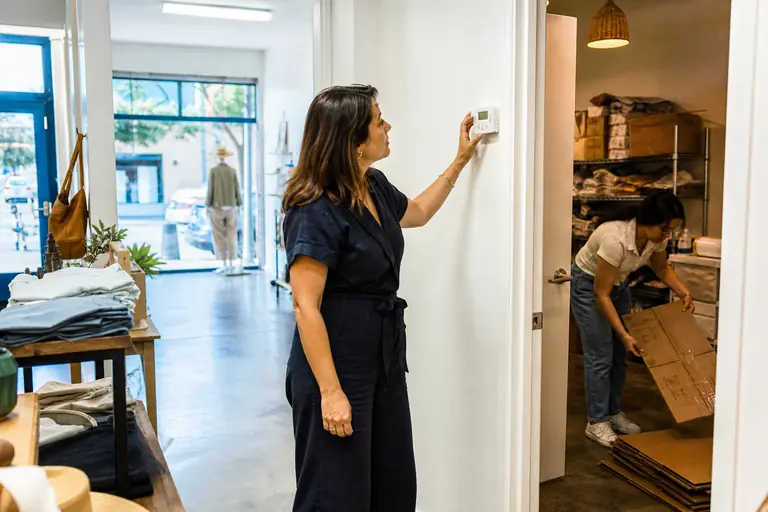
The fastest way to green a retail store’s daily operations is to cut energy first, then waste and water. Switch to LED lighting with controls, tune HVAC and refrigeration, manage your SDG&E time-of-use costs, set up recycling and organics collection that meets California law, and buy fewer, better supplies. Most of these steps lower operating costs within months, and each gives you a specific, provable claim to share with customers.
Start with energy, the biggest cost
Lighting
Lighting runs every hour the store is open and often longer. LED fixtures use far less electricity than fluorescent or halogen lighting, last longer and produce less heat, which also reduces cooling load. Add occupancy sensors in stockrooms, restrooms and offices, and use timers or a simple controls system so lights don’t run overnight. Dim or switch off window and sign lighting after close, within any limits your lease or city sign rules set. For display lighting, LED track heads give you better color for merchandise. Our guide to LED lighting retrofit payback shows how to estimate savings.
Heating and cooling
San Diego’s mild climate means many stores can run HVAC less than they do. Set schedules that match store hours, start cooling a little before opening instead of running all night, keep the front door closed when the system is running, and keep vents clear of displays and stock. Get rooftop units serviced regularly: clean filters and coils, check refrigerant and fix economizers, which bring in cool outside air when conditions allow. When a unit nears the end of its life, compare high-efficiency replacements, including heat pumps.
Refrigeration
For stores with coolers or freezers, refrigeration can be the largest electric load. Add doors or night curtains to open cases, replace worn door gaskets, keep coils clean and check that defrost cycles and temperatures are set correctly. Efficient fan motors and LED case lighting are common upgrades.
Manage when you use power
Most SDG&E business customers are on time-of-use rates, where electricity costs more during late afternoon and evening peak hours. A store open until 8 p.m. uses power right through the most expensive window. Shift what you can, such as pre-cooling before the peak, running dishwashers or laundry earlier and charging equipment off-peak. Review your rate plan with SDG&E, since the right plan depends on your hours and load. SDG&E has also offered business energy programs and on-bill financing for efficiency upgrades. Check current offers and eligibility before you buy equipment.
Waste: recycling, organics and less of both
California law requires businesses that generate enough waste to arrange recycling service (AB 341) and organics recycling (AB 1826 and SB 1383). In San Diego, your hauler or city environmental services department can tell you what service level your store needs and what goes in each bin. Set your store up to make it easy:
- Put clearly labeled recycling and organics bins next to every trash bin, including the break room.
- Flatten and bale cardboard if you generate a lot. Some haulers charge less for clean, separated cardboard.
- Ask suppliers to take back pallets, hangers and shipping materials, or to ship in reusable totes.
- Offer digital receipts, and stock only the checkout bags state law allows.
- Donate unsold usable goods instead of discarding them. Food retailers may have donation duties under SB 1383.
Right-size your service once your diversion improves. If your trash bin is half empty at pickup, you may be able to reduce container size or frequency and save money. Watch contamination, too. A recycling bin full of food-soiled packaging or plastic film may be charged as trash.
Water and supplies
Retail stores use less water than restaurants, but restrooms and any landscaping still count. Replace older faucets, toilets and urinals with EPA WaterSense labeled models, fix leaks promptly and set irrigation on a smart controller. For supplies, choose cleaning products with credible third-party certification, buy concentrates, use refillable dispensers and stop buying single-use items you don’t need. Track what you buy, since purchasing data is the easiest way to show progress.
Look at what you sell as well. Stocking refills, running a take-back program for your own packaging or highlighting products with documented recycled content carries your operational changes into the product mix, where customers see them most.
Make it stick with staff and data
- Pick a starting baseline: 12 months of SDG&E bills, water bills and waste invoices.
- Choose two or three projects with the clearest payback and do them first.
- Write simple routines for opening and closing, such as lights, HVAC settings and door checks.
- Train staff on the bins and the reasons behind them, and assign one person to check them weekly.
- Review bills quarterly and share results with staff and customers.
Customers respond to specifics. A sign that says “We switched to LED lighting and cut our electricity use” works better when you can name the number. Shops in our sustainable products and retail network use this kind of measured story to stand out.
How chamber membership helps
Every San Diego Green Chamber member commits to reducing energy and water use, so you will be among retailers working on the same goals. Membership includes education and resources, a Member Business Directory listing, U.S. Green Chamber membership and free networking co-hosted with San Diego Green Drinks, where you can meet the contractors and suppliers who do this work. Learn about membership.
Questions
What is the quickest energy win for a retail store?
LED lighting with basic controls is usually the fastest payback, followed by HVAC scheduling and maintenance.
Do retail stores have to recycle in California?
Businesses that generate enough waste must arrange recycling and organics service under AB 341, AB 1826 and SB 1383. Ask your hauler or city what applies to your store.
How do time-of-use rates affect my store?
Electricity costs more during late afternoon and evening peak hours, so stores open into the evening pay more. Shifting loads and choosing the right plan can help.
Are there SDG&E programs for store upgrades?
SDG&E has offered business efficiency programs and on-bill financing. Check current offers and eligibility with SDG&E before buying equipment.
Prove it. Get referred for it.
Join the San Diego Green Chamber to get listed, introduced and referred by businesses that check.